Bio-Inspired AI & Optimization — Course Visualizations
Supplemental visualizations for Theodore Pavlic's IEE/CSE 598: Bio-Inspired AI and Optimization at Arizona State University.
Lectures and other helpful short video tutorials can be found at TedPavlic's YouTube channel.
© 2026 Theodore P. Pavlic · MIT License
Genetic Algorithms
-
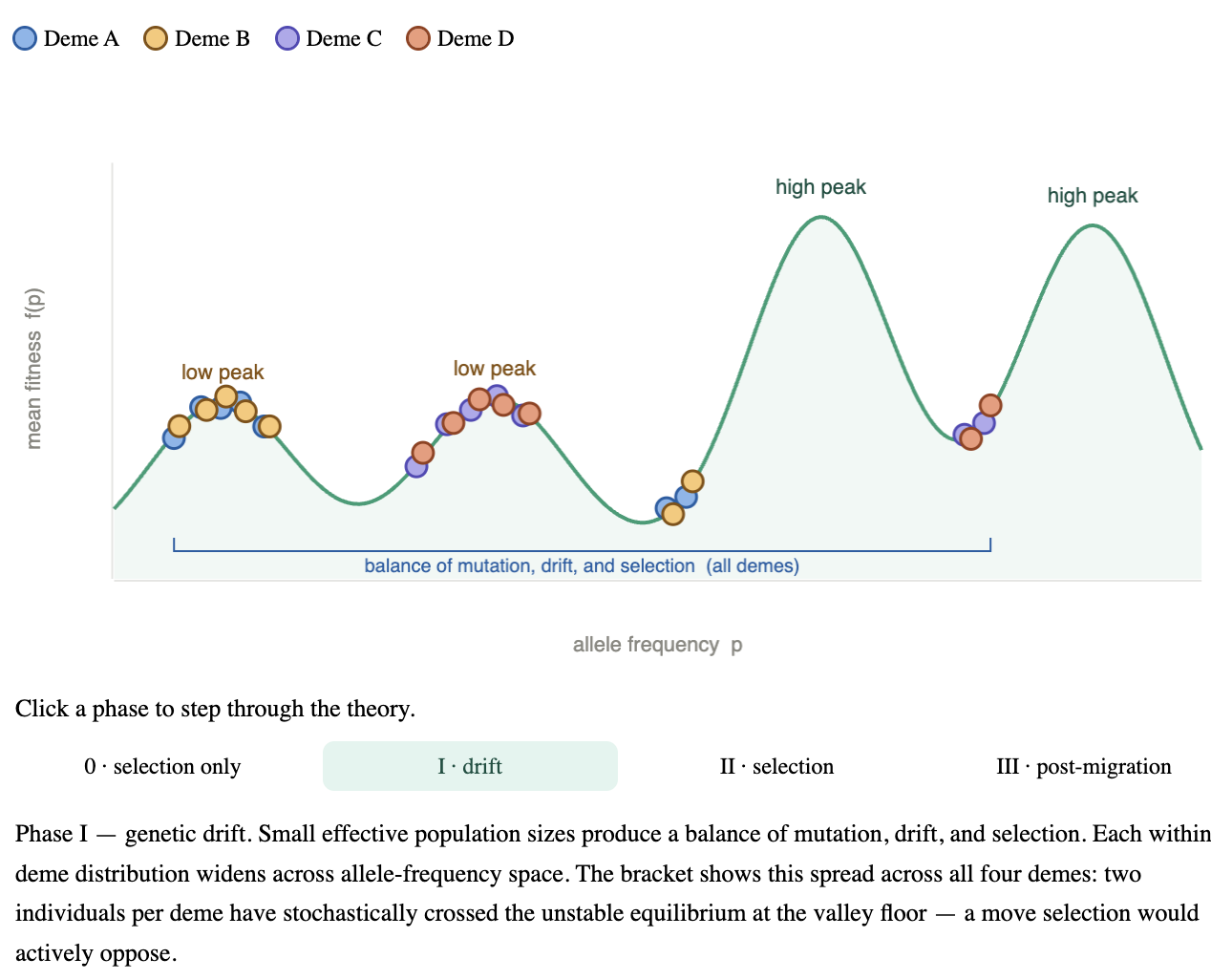
Shifting Balance Theory — interactive explainer
Walk through Sewall Wright's three-phase Shifting Balance Theory: how genetic drift, selection, and interdemic migration help a metapopulation escape local fitness peaks.
-
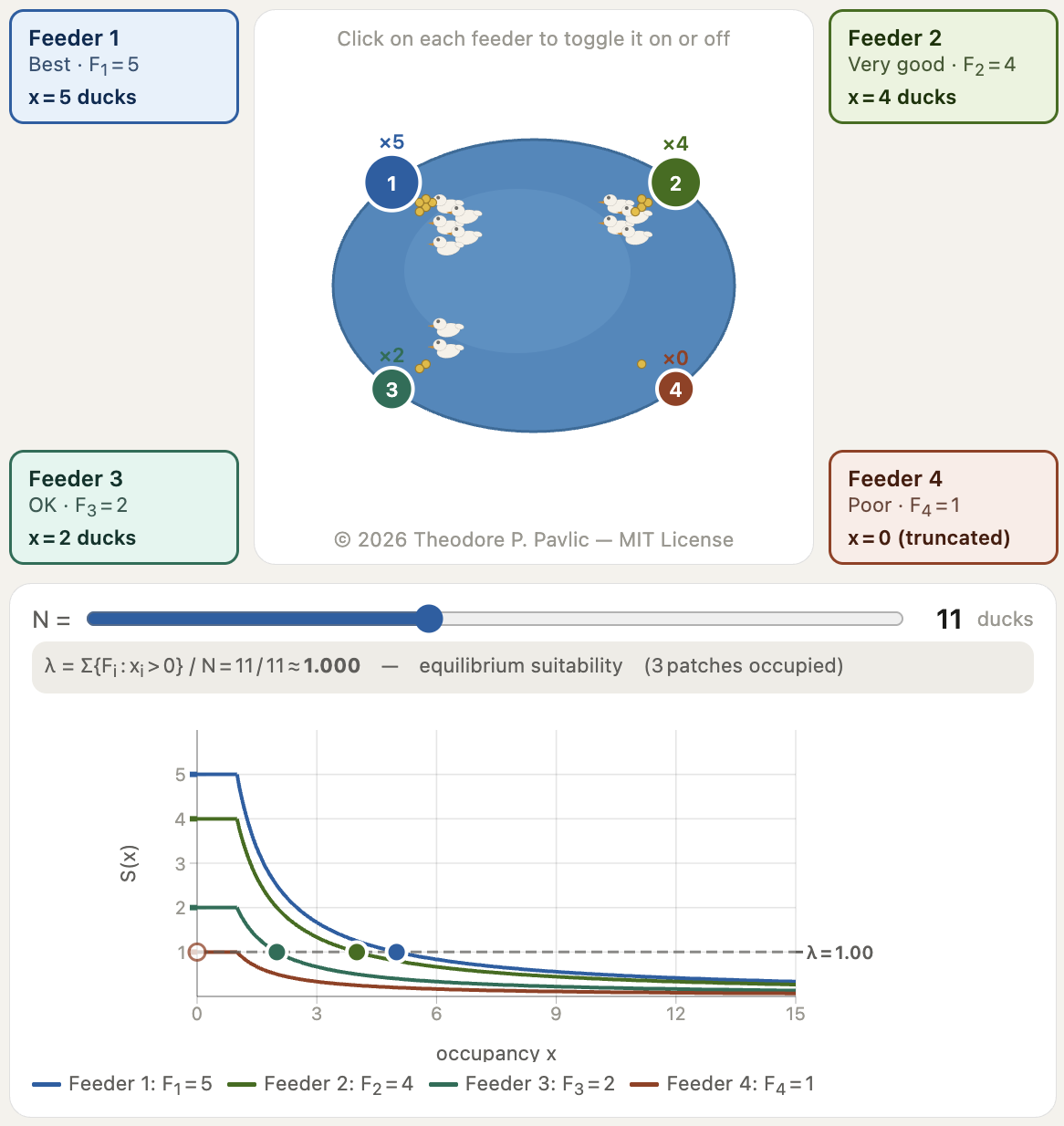
Ideal Free Distribution — interactive explainer
Watch animals distribute across resource patches to equalize individual fitness — a behavioral ecology result that motivates fitness sharing in multi-modal genetic algorithms.
-
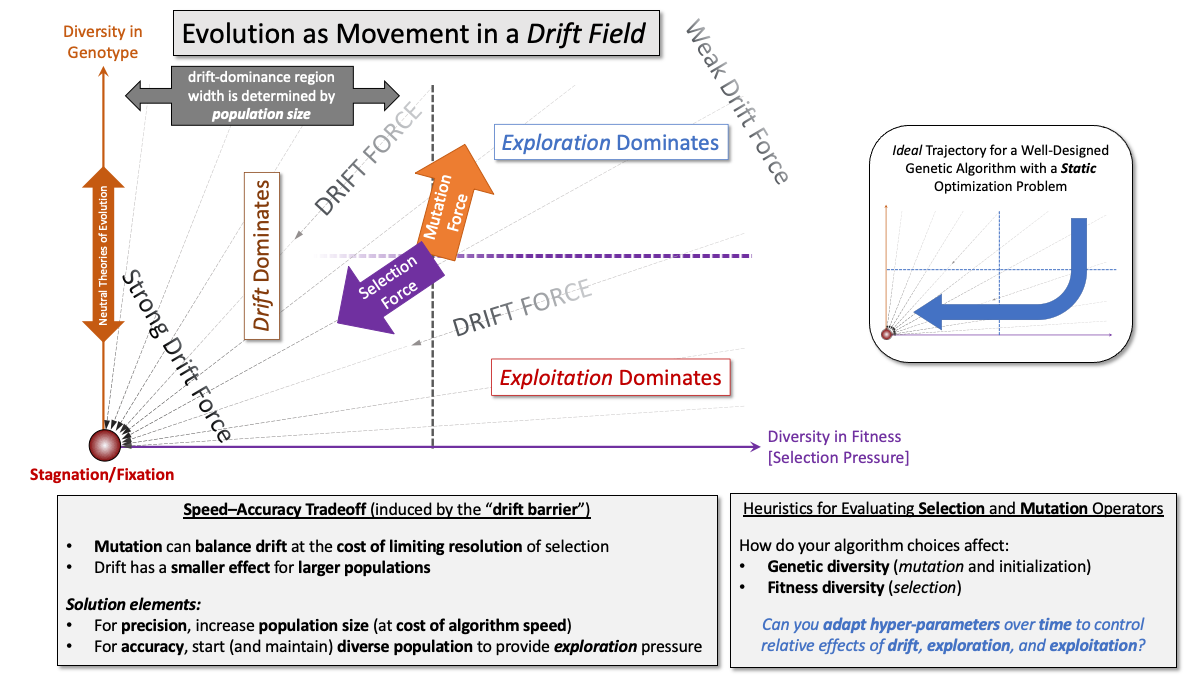
Evolution as Movement in a Drift Field — graphical explainer
Selection and drift purge diversity; mutation replenishes it. This figure frames the four forces of evolution as a field pushing populations toward fixation, motivating how to tune GA hyperparameters for a gradual shift from exploration to exploitation.
-
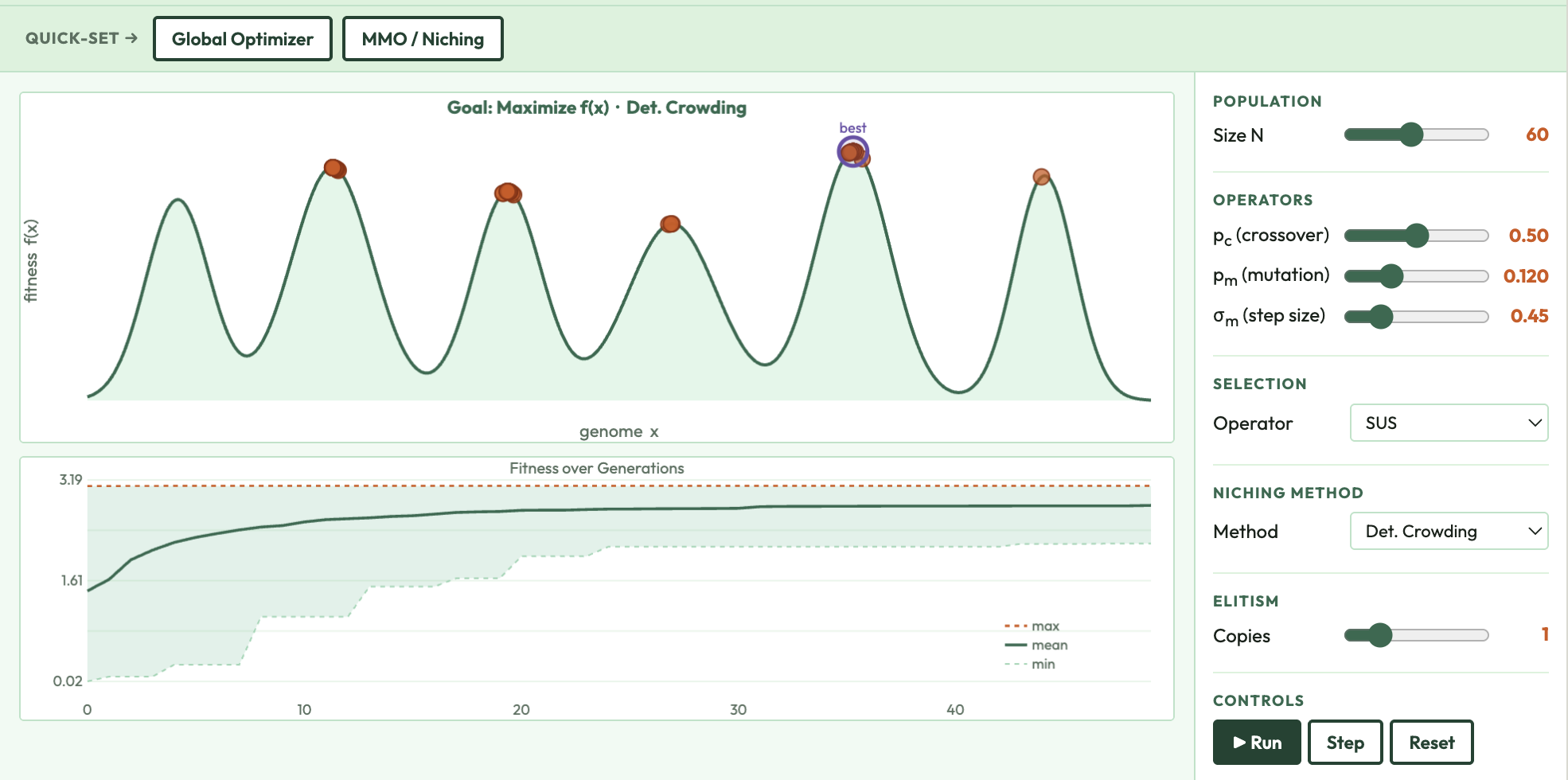
Genetic Algorithm Explorer — interactive explainer
Run a canonical GA on a 1-D multimodal landscape with niching, experiment with an island model / distributed GA, explore a 2-D optimization zoo, and watch a two-objective MOEA build a Pareto front in real time.
Evolution Strategies
-
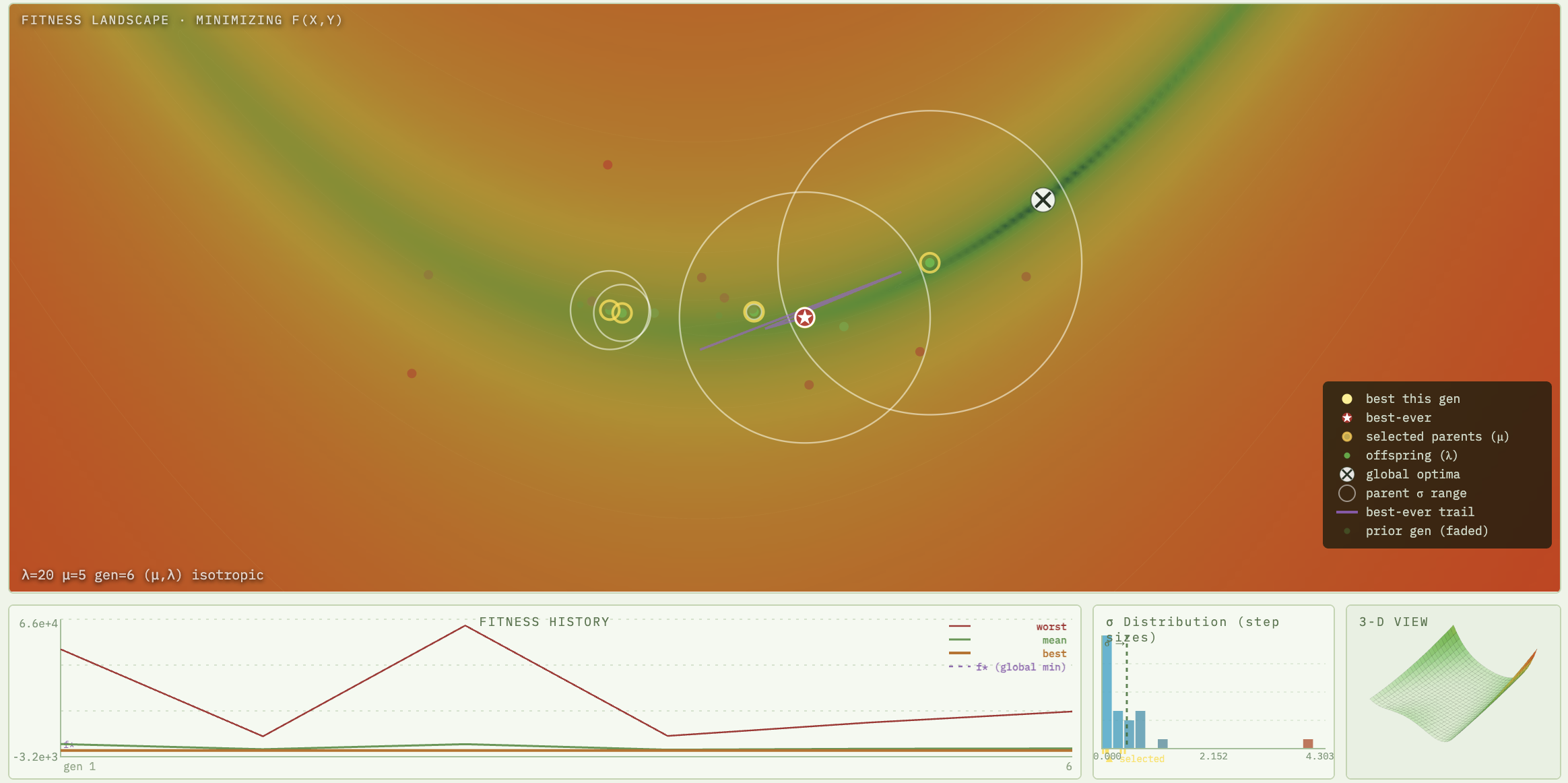
ES Explorer — interactive explainer
Run a (μ,λ)- or (μ+λ)-Evolution Strategy on a 1-D multimodal landscape and watch per-individual step sizes self-adapt through selection — no global update rule required.
-
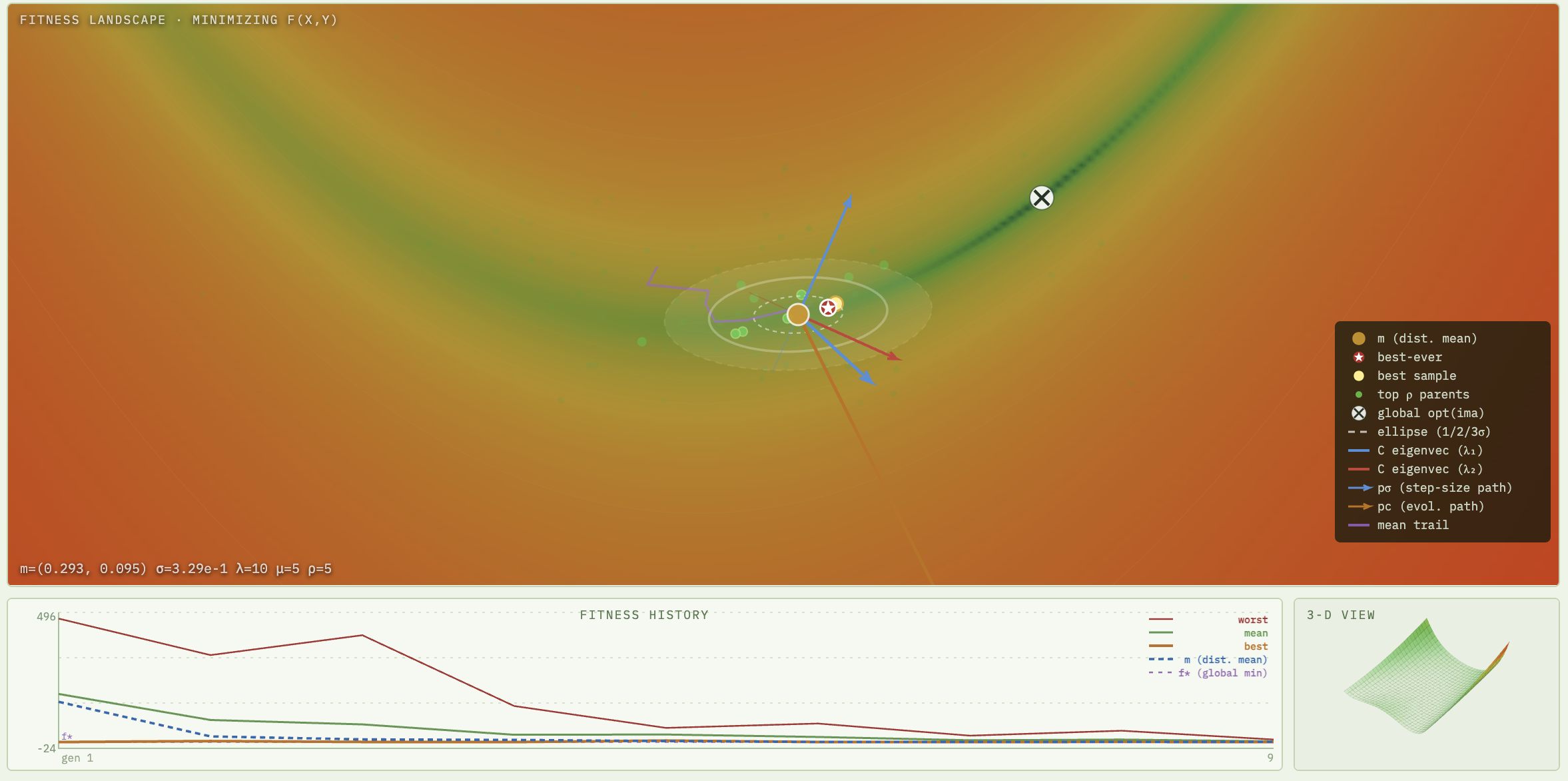
CMA-ES Explorer — interactive explainer
Watch CMA-ES adapt its mean, step size, and full covariance matrix each generation — cumulative step-size adaptation and rank-1/rank-μ covariance updates visualized in real time on a 2-D landscape.
Evolutionary Programming & Artificial Immune Systems
-
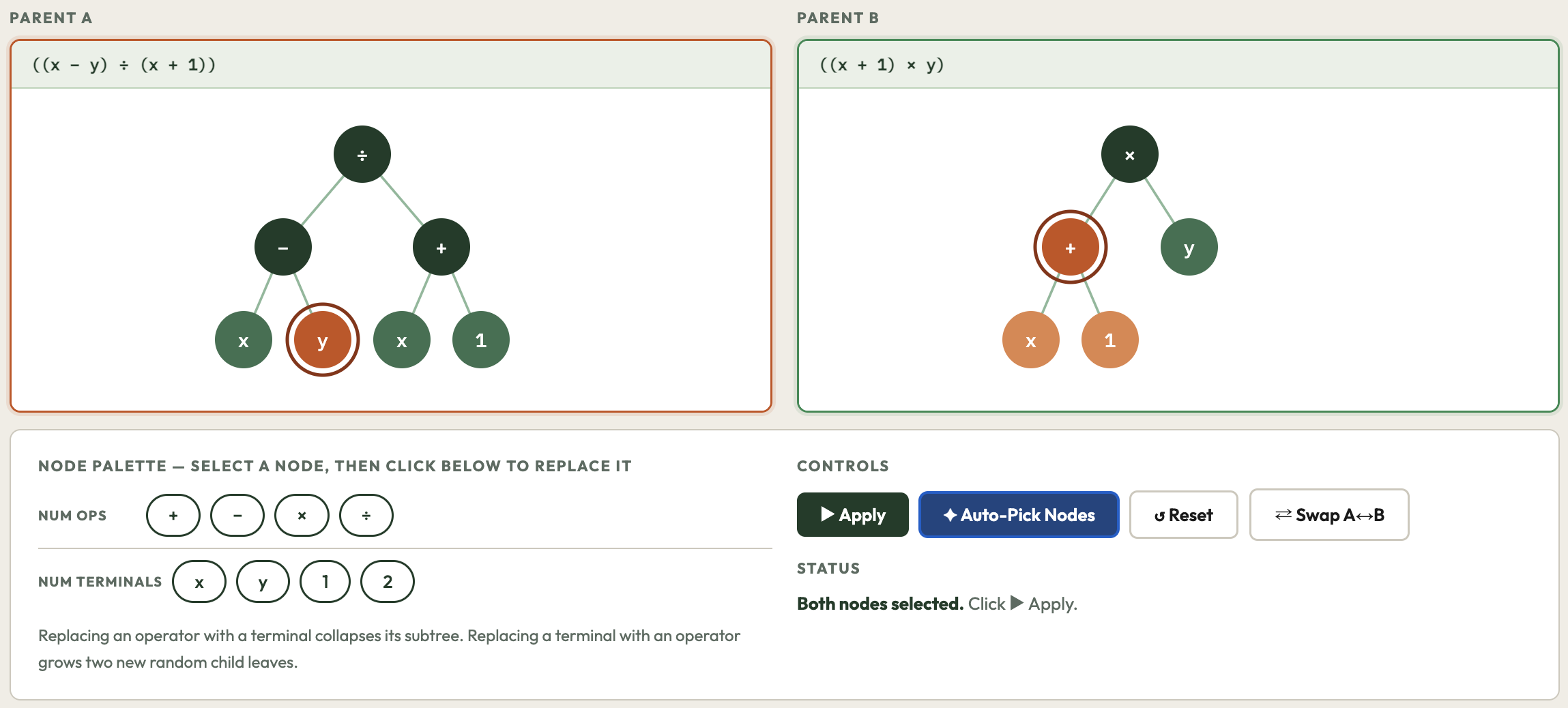
Evolutionary Programming Representations — interactive explainer
Explore Abstract Syntax Trees, Linear Genetic Programs, and Finite-State Machines side by side — interact with each representation, apply variation operators, and compare their expressiveness and typical applications.
-
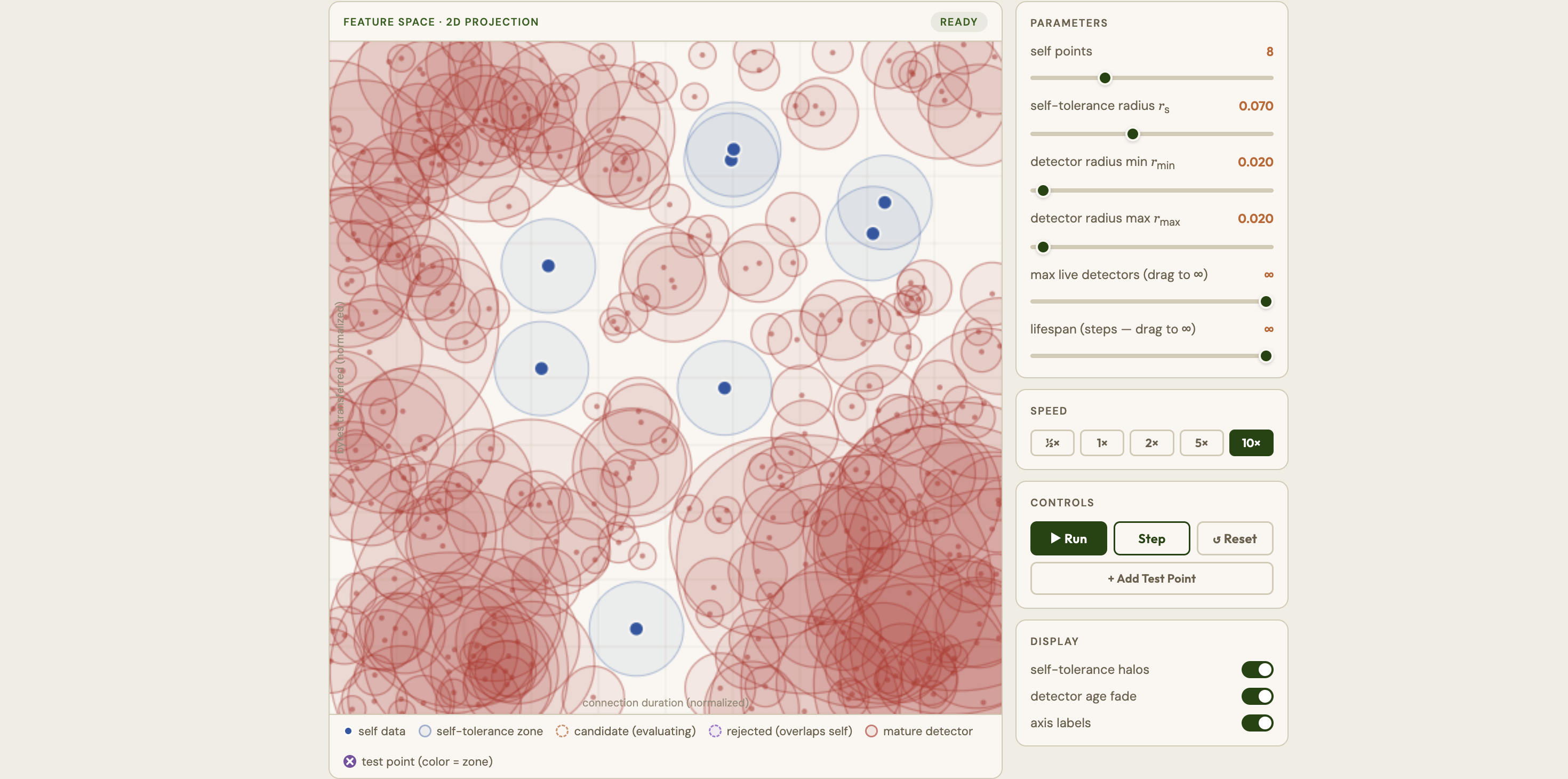
Artificial Immune Systems Explorer — interactive explainer
Explore Negative Selection (NSA) and CLONALG side by side — watch detectors train on self-data to flag anomalies, and see how clonal selection and affinity maturation build a pattern-recognition repertoire.
Physics-Inspired Methods
-
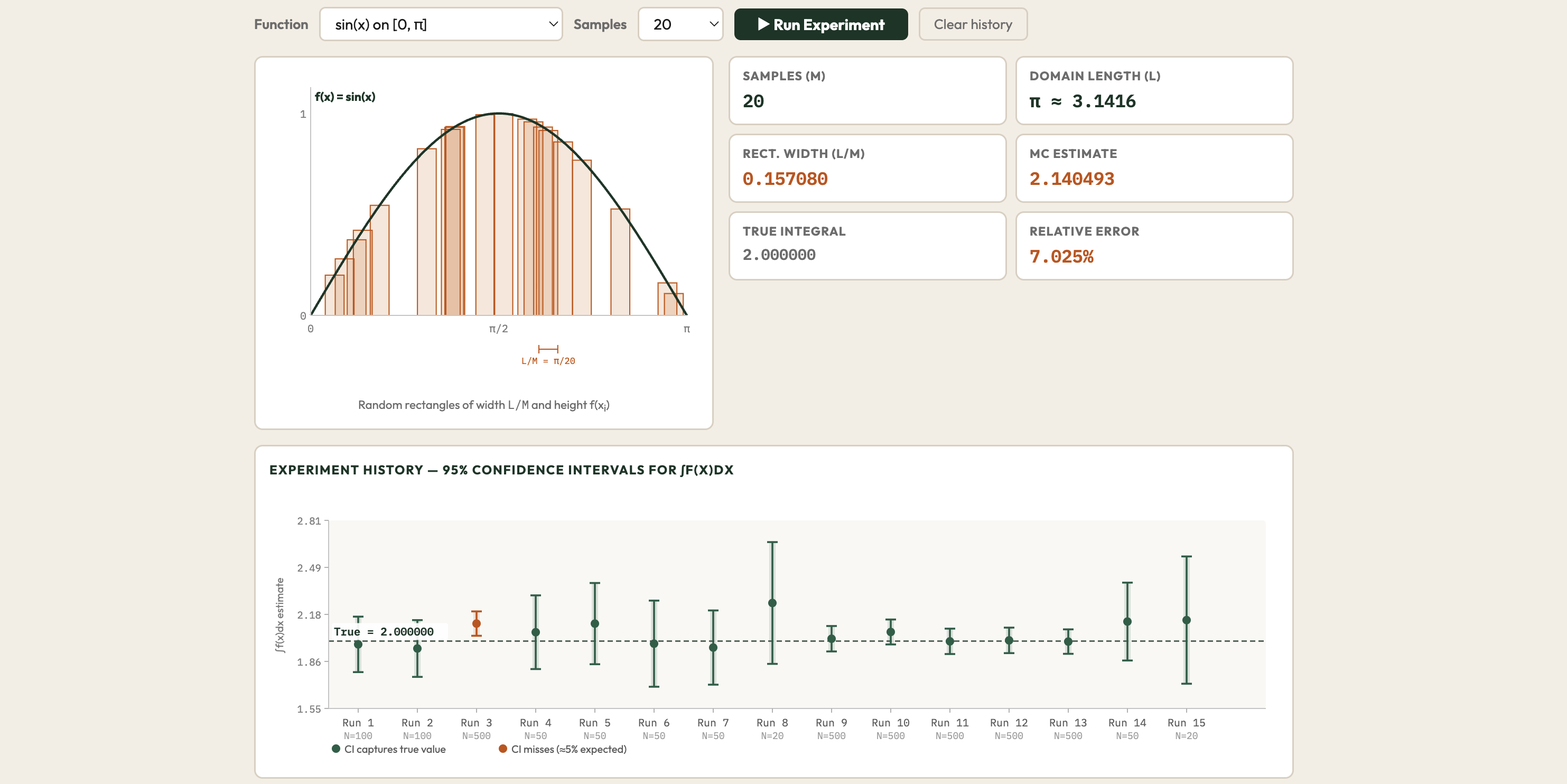
Monte Carlo Explorer — interactive explainer
Estimate π by dartboard sampling and integrate a function by averaging random draws, running repeated experiments to watch 95% confidence intervals accumulate around the true value.
-
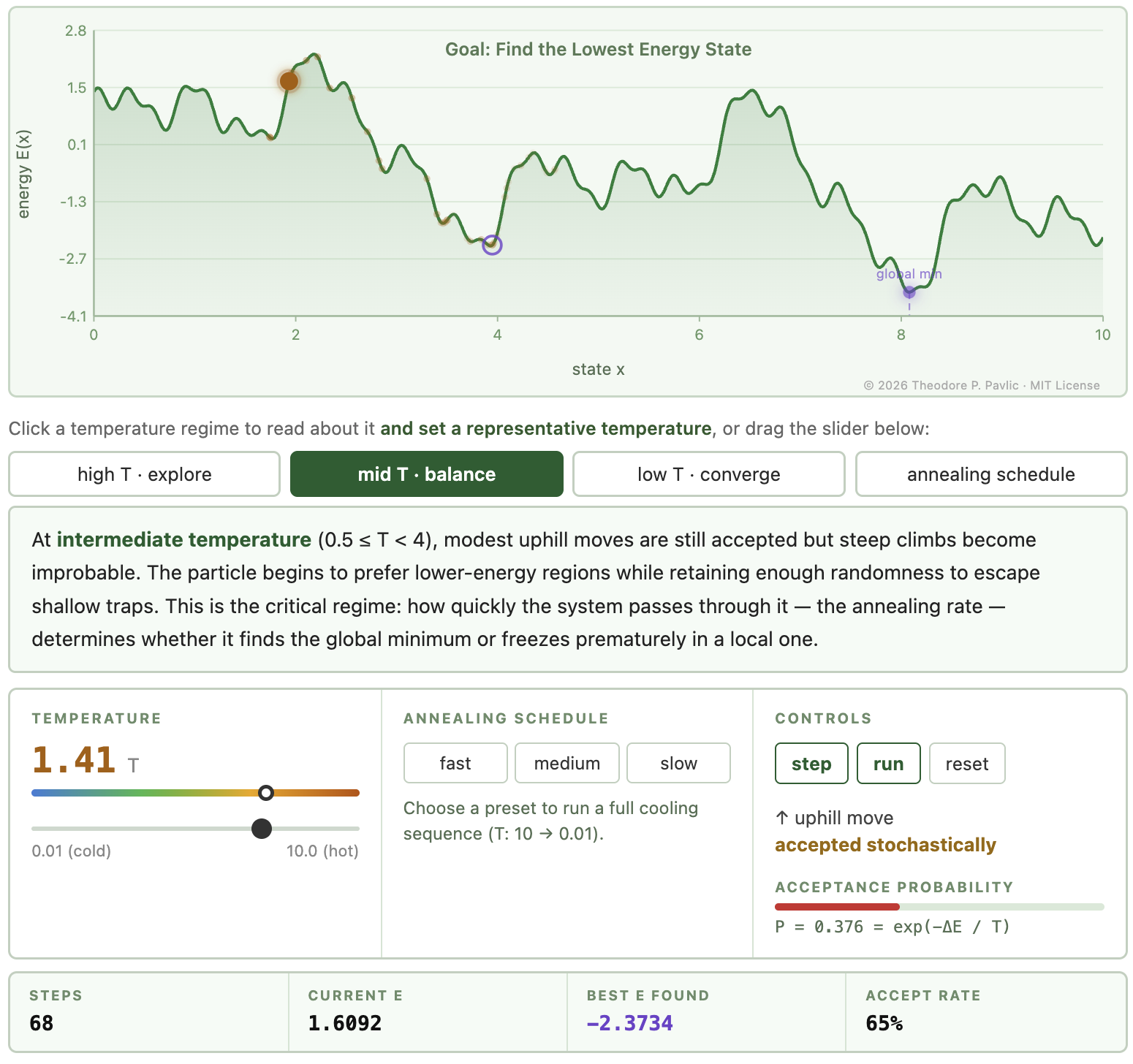
Simulated Annealing — interactive explainer
Step through the annealing process: temperature schedules, neighbor selection, and probabilistic acceptance criteria on an energy landscape.
-
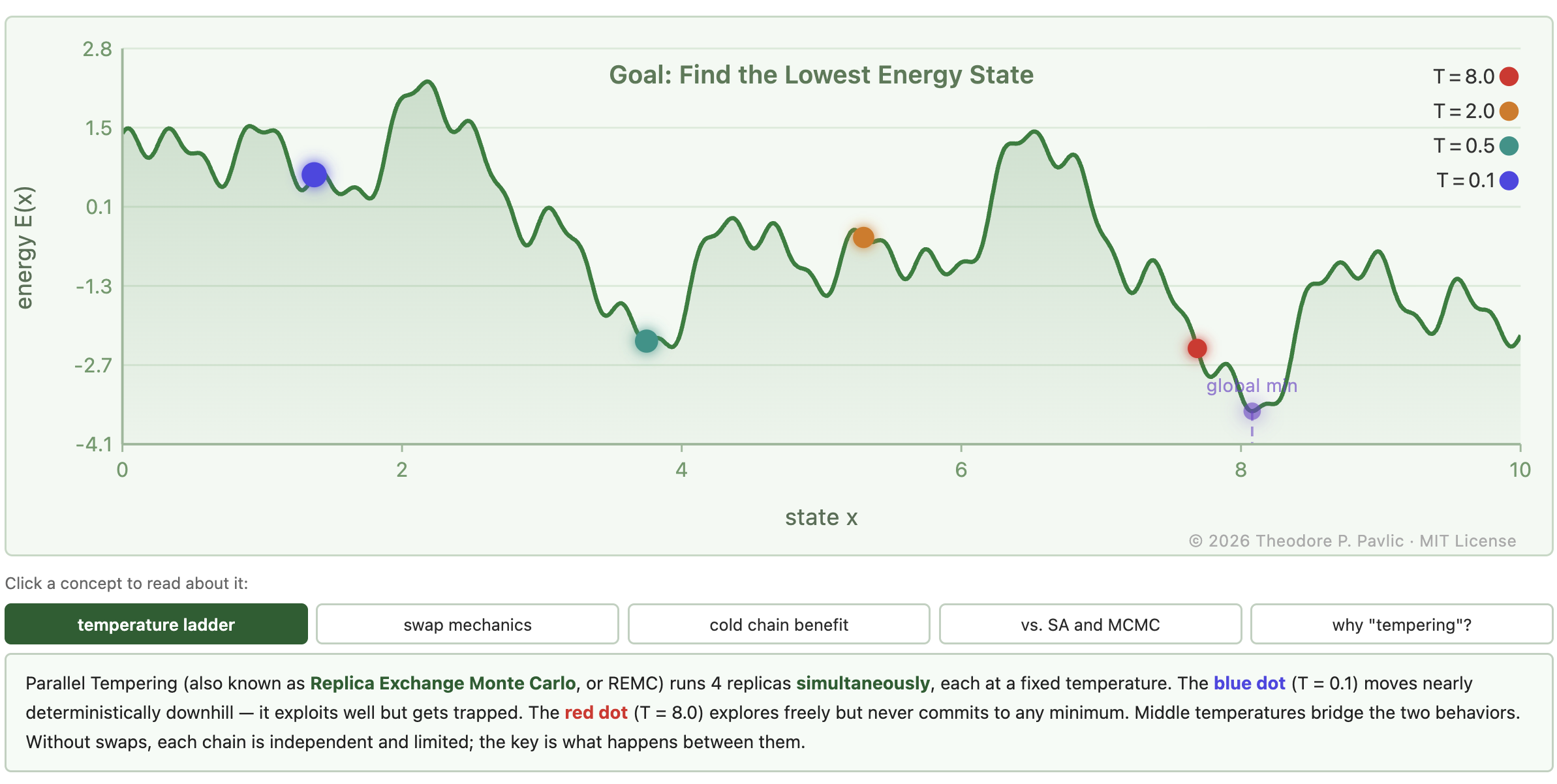
Parallel Tempering / REMC — interactive explainer
Run parallel fixed-temperature SA replicas at different temperatures and periodically swap configurations between them — high-temperature replicas explore globally while low-temperature ones refine solutions.
-
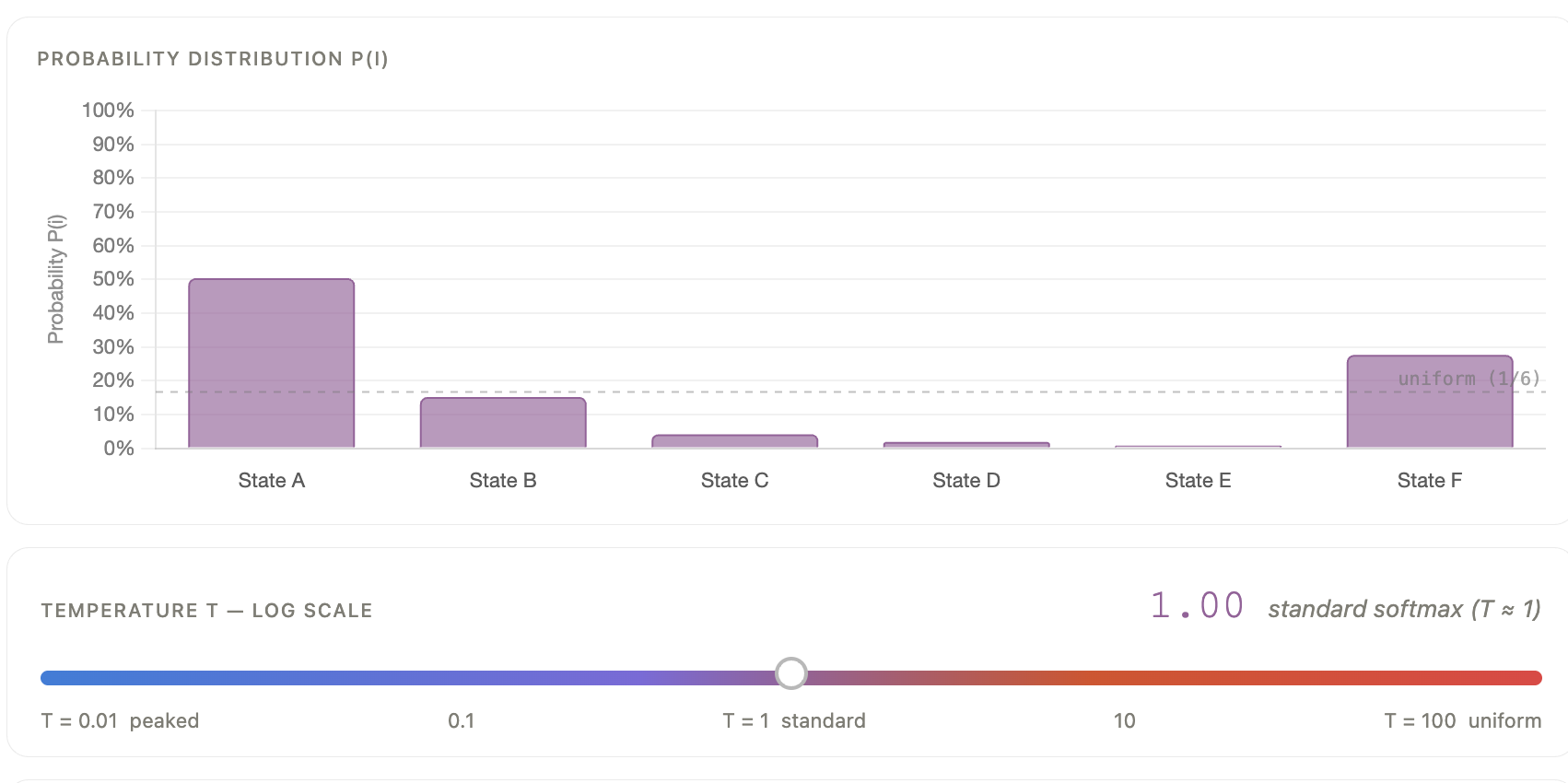
Softmax Temperature Explorer — interactive explainer
Adjust the temperature of the softmax (Gibbs) distribution and watch how it interpolates between uniform exploration and greedy exploitation — the same mechanism underlying SA acceptance and MaxEnt methods.
-
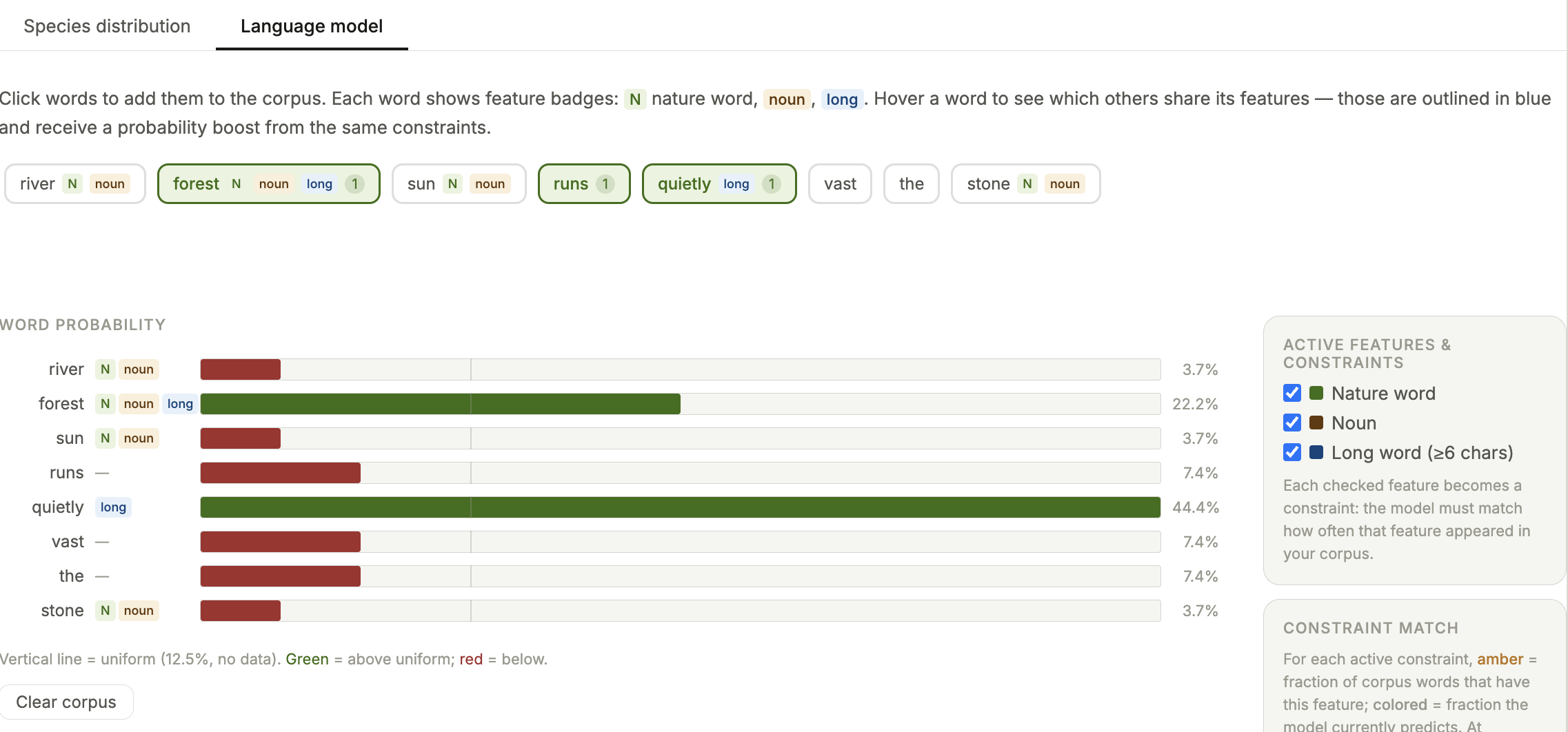
Maximum Entropy (MaxEnt) — interactive explainer
Explore how the Maximum Entropy principle selects the least-assumptive distribution consistent with known constraints — and how this derivation produces the Gibbs/softmax distribution that underlies SA acceptance probabilities.
-
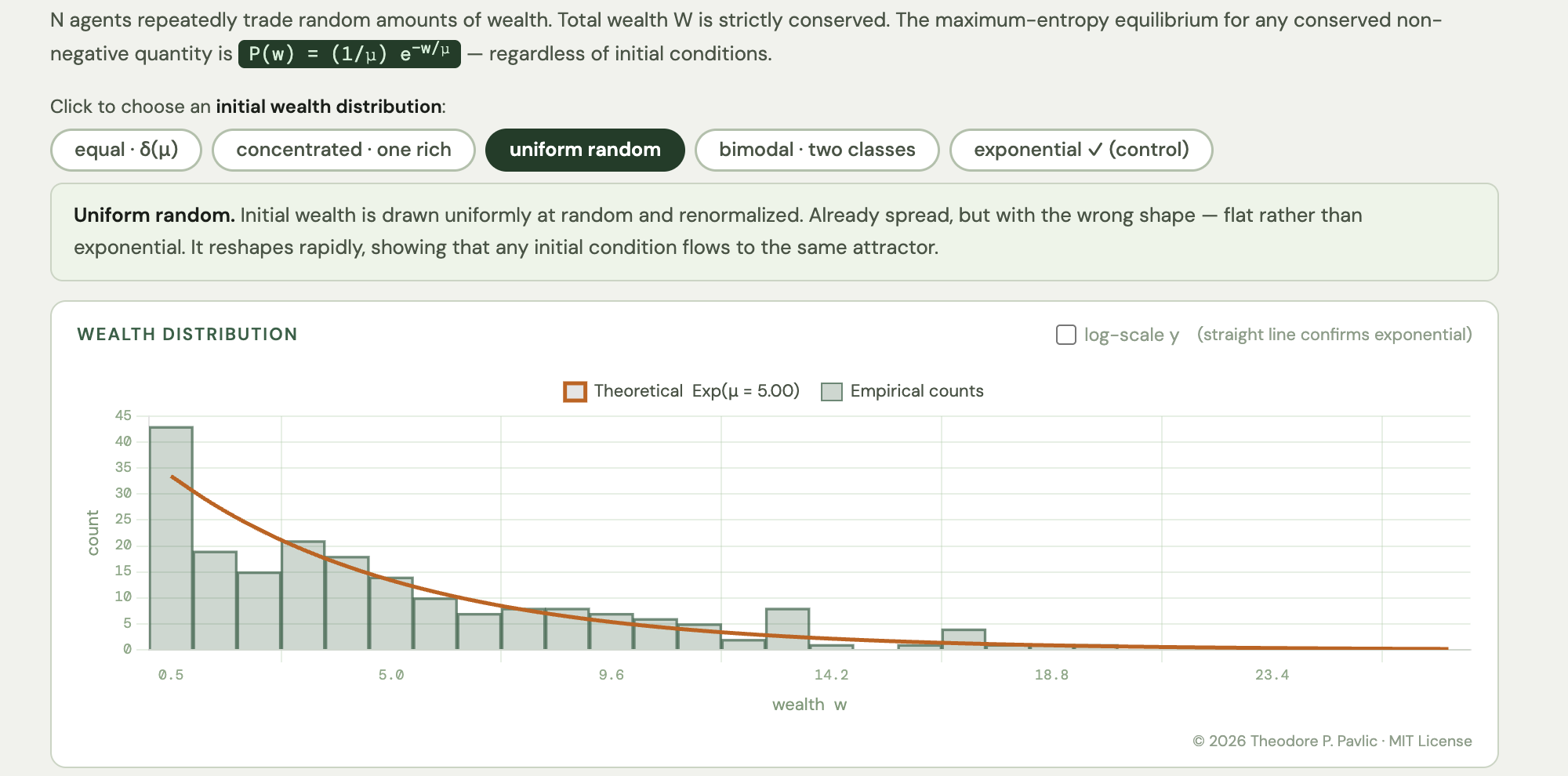
Boltzmann Distribution via Random Exchange — interactive explainer
N agents repeatedly trade random amounts of a conserved quantity — watch any starting distribution relax to the maximum-entropy Boltzmann (exponential) equilibrium, confirming the statistical mechanics origin of the Gibbs distribution.
-
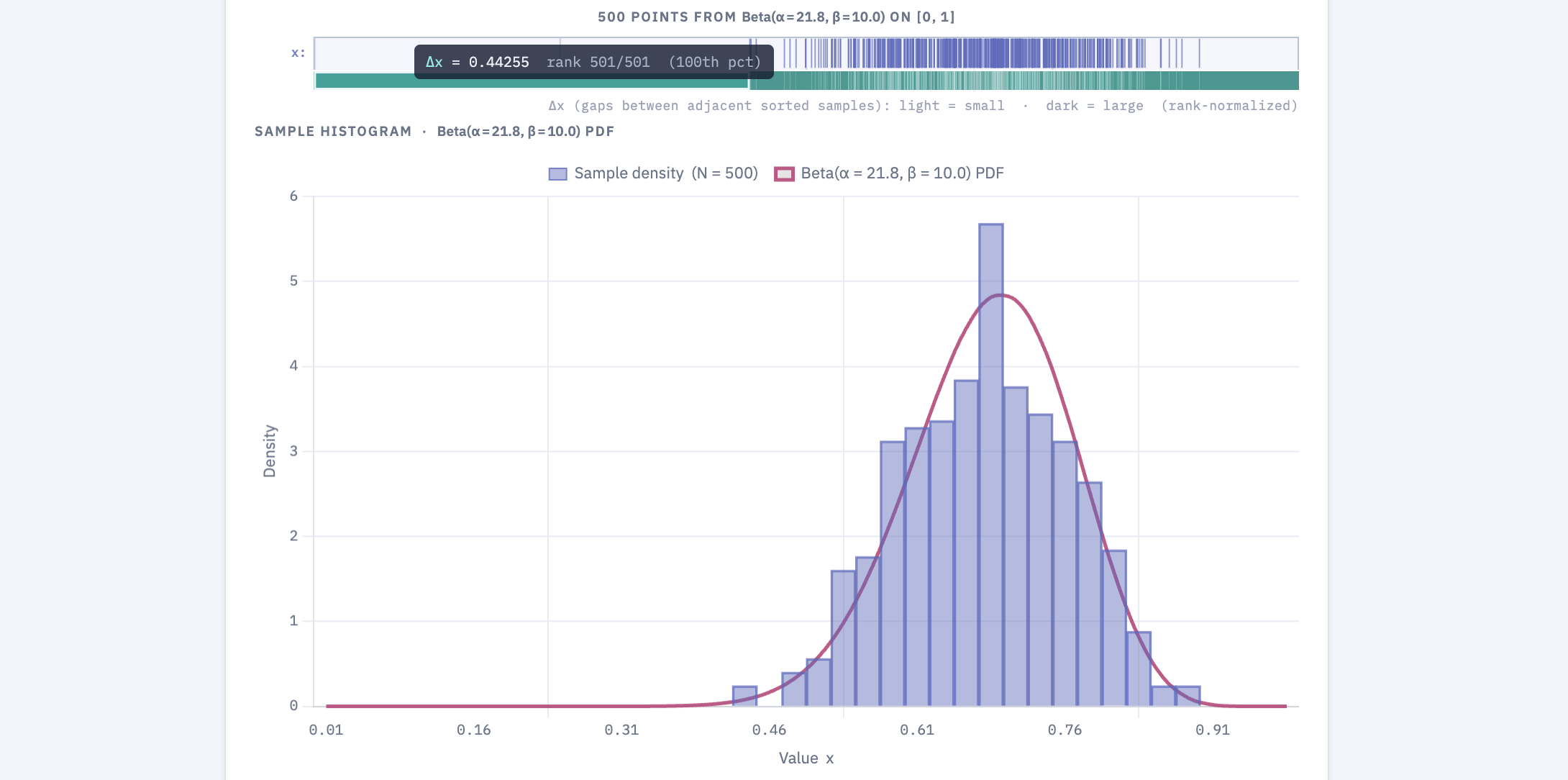
Beta Distribution Explorer — interactive explainer
Adjust α and β to reshape the Beta(α,β) distribution, draw N samples, and watch how their order statistics and spacings reveal the deep connection between uniform random variables and the Beta distribution.
Swarm Intelligence
-
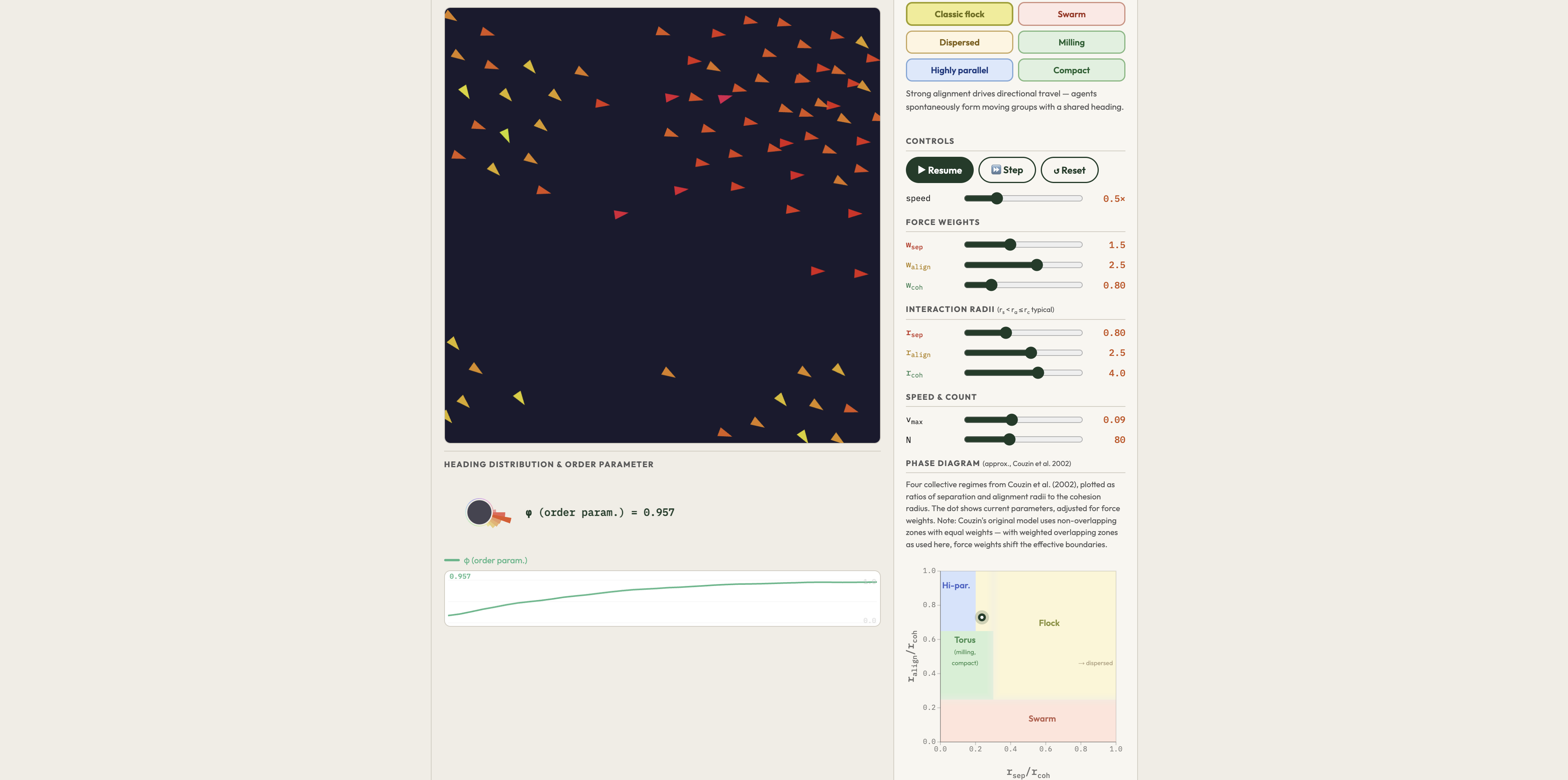
Boids Explorer — interactive explainer
Tune separation, alignment, and cohesion weights in Reynolds' Boids model to watch emergent flocking arise from three simple local rules — a classic model of collective motion that inspired swarm intelligence algorithms like PSO.
-
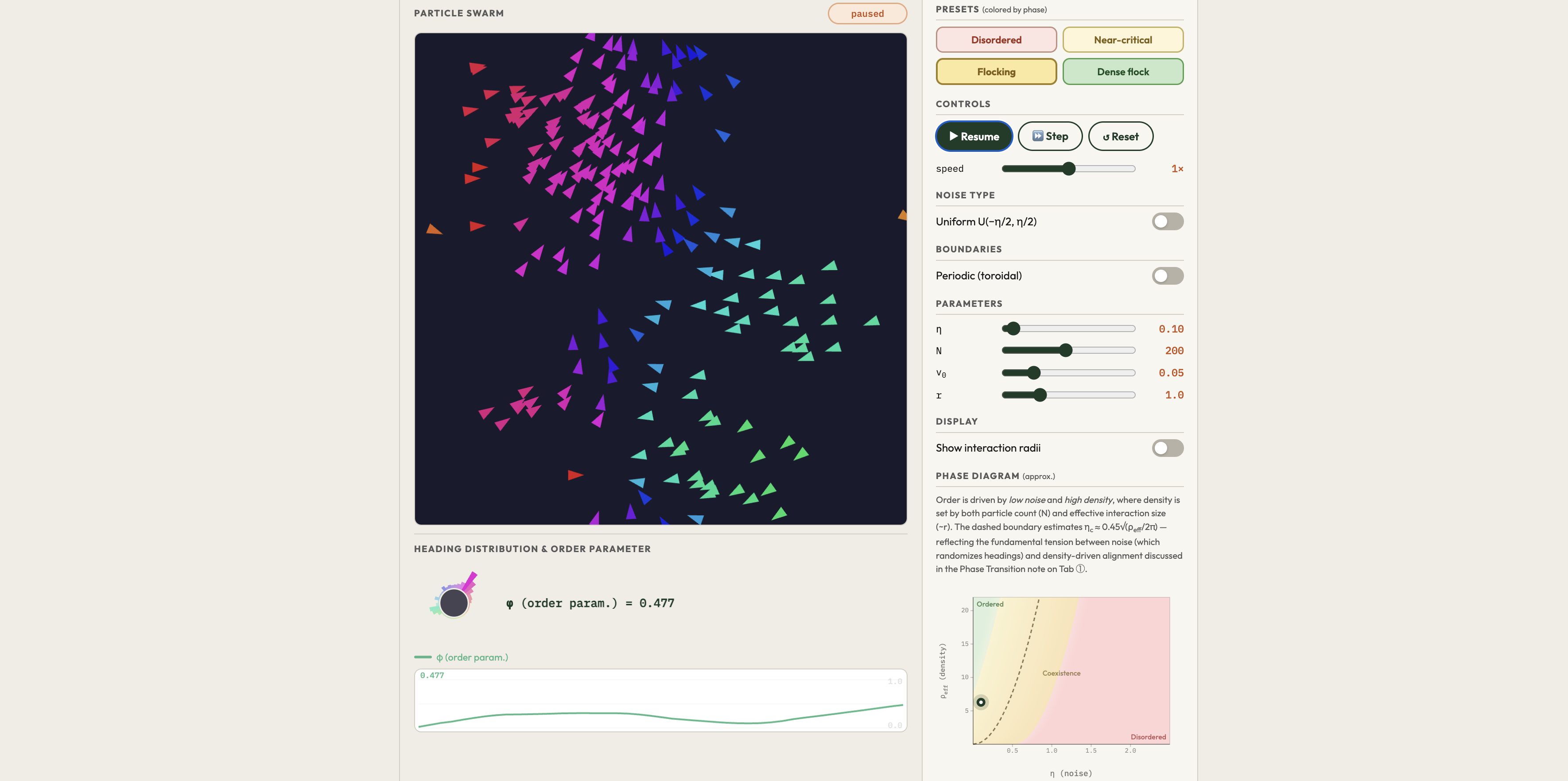
Vicsek Model Explorer — interactive explainer
Adjust noise and interaction radius in the Vicsek model to watch self-propelled particles transition between disordered flocking and coherent swarm behavior — a minimal model of collective motion in biological and robotic swarms.
-
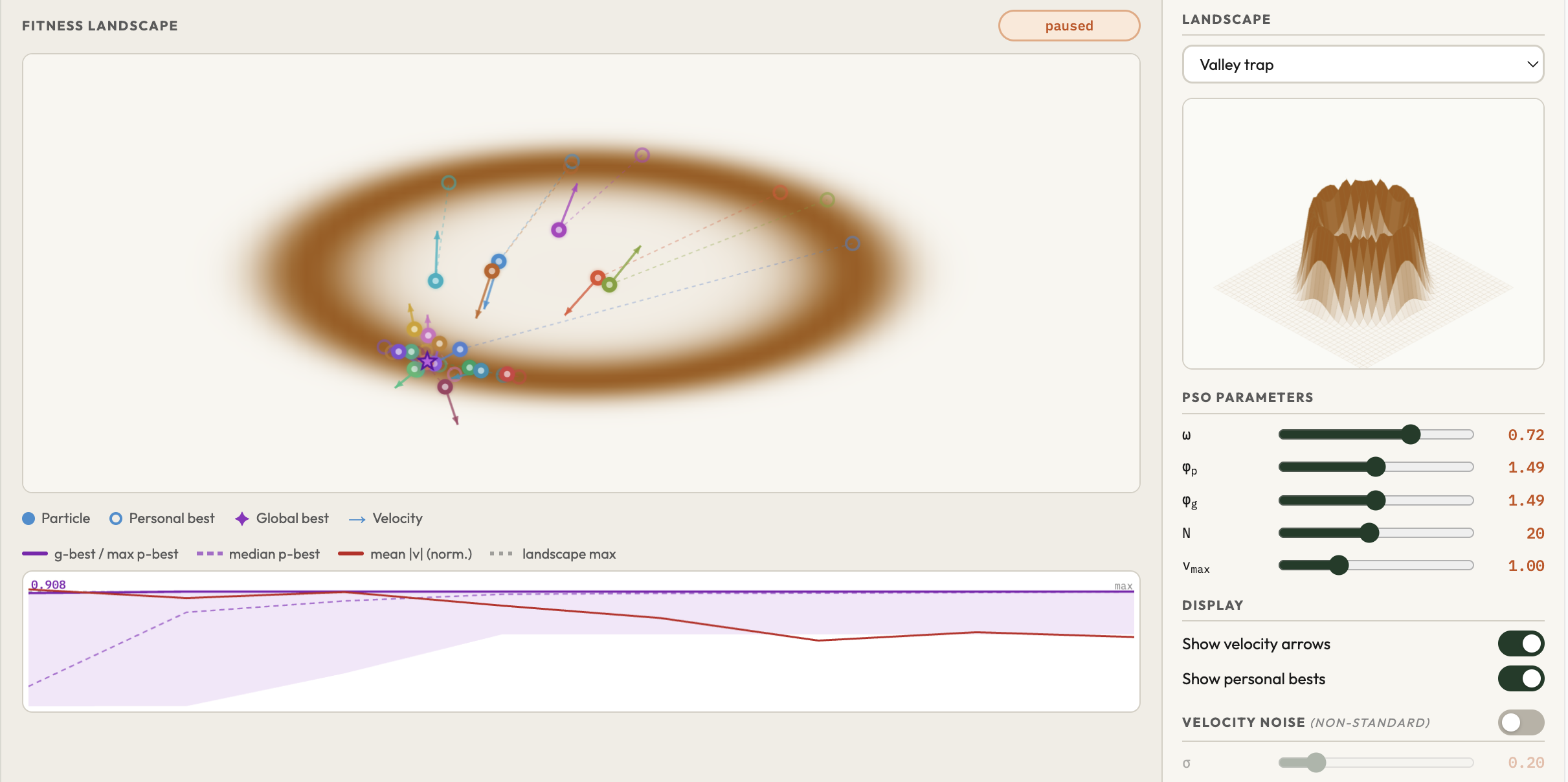
Particle Swarm Optimization (PSO) Explorer — interactive explainer
Step through the PSO velocity-update rule — inertia, cognitive, and social components — then run a live swarm on a 2-D landscape and watch particles collectively converge on optima.
-
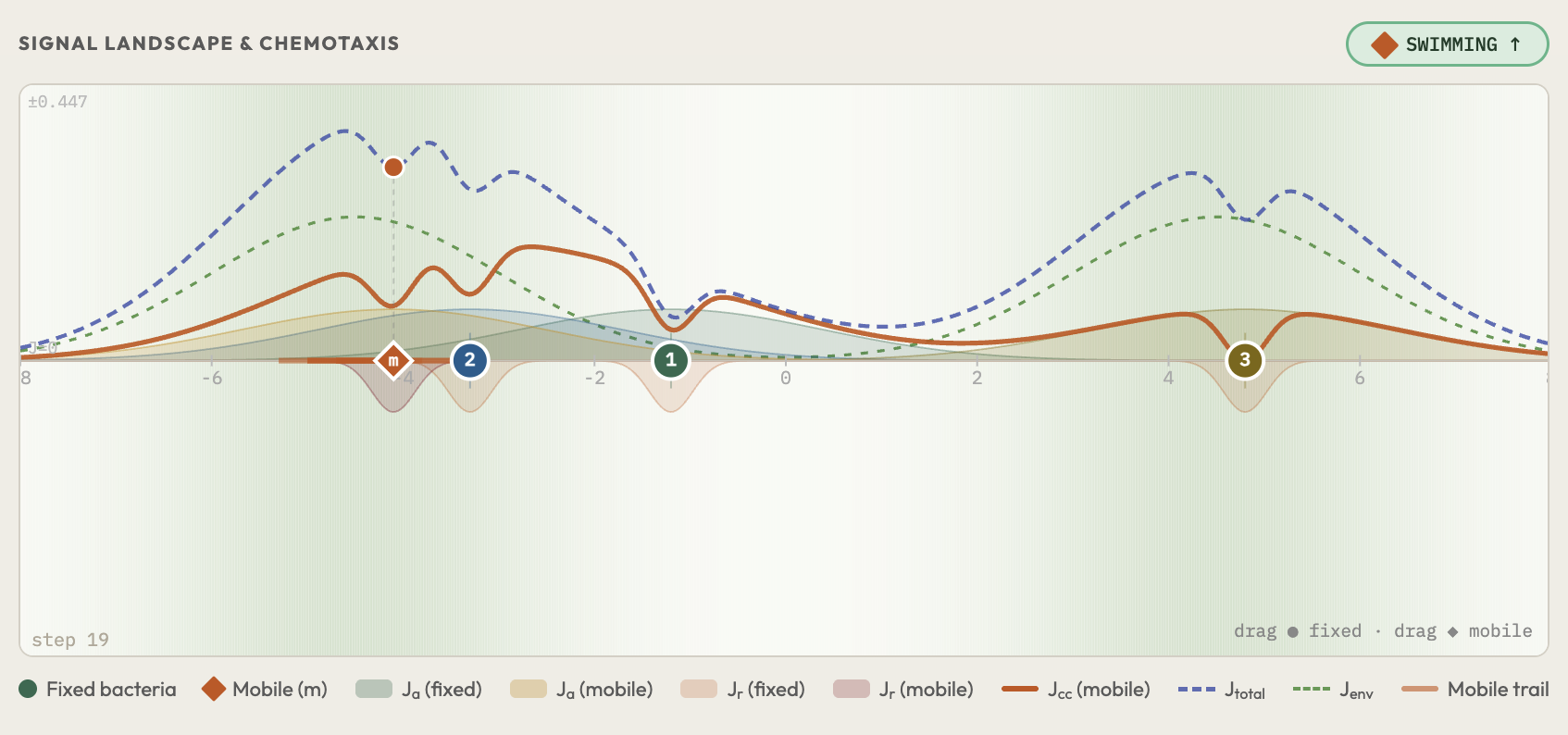
Bacterial Foraging Optimization (BFO) Explorer — interactive explainer
Run the complete Bacterial Foraging Optimization algorithm (Passino 2002): experiment with cell-to-cell attractant/repellent signaling and tumble-swim chemotaxis in 1-D and 2-D, then step through the full nested loop — chemotaxis, reproduction, and elimination-dispersal — to watch a swarm collectively locate optima.
-
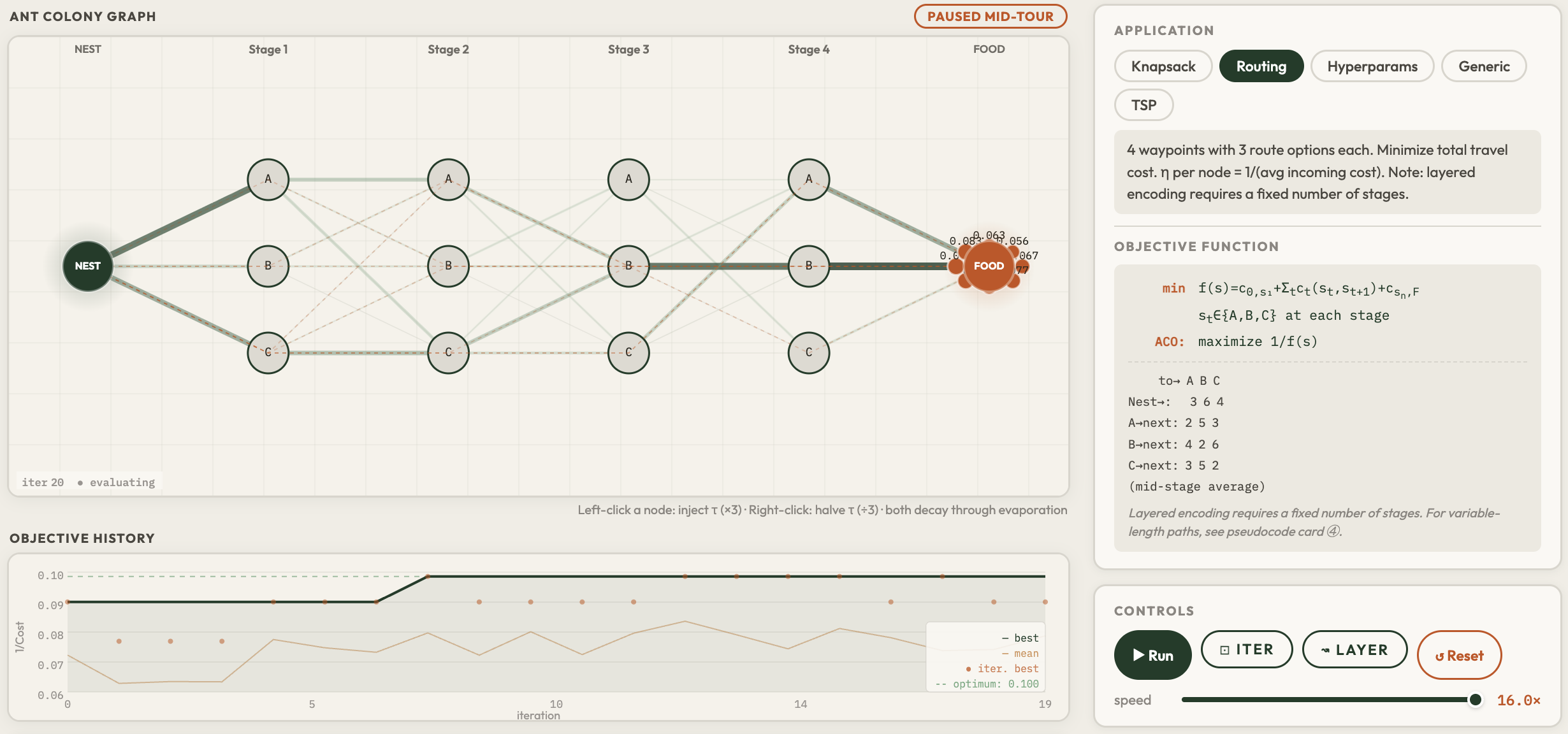
ACO / Ant System Explorer — interactive explainer
Watch a pheromone-guided ant colony tackle a layered combinatorial problem and a Travelling Salesman Problem — adjust evaporation rate, deposit scale, and exploitation bias to see how stigmergic reinforcement drives collective search.
-
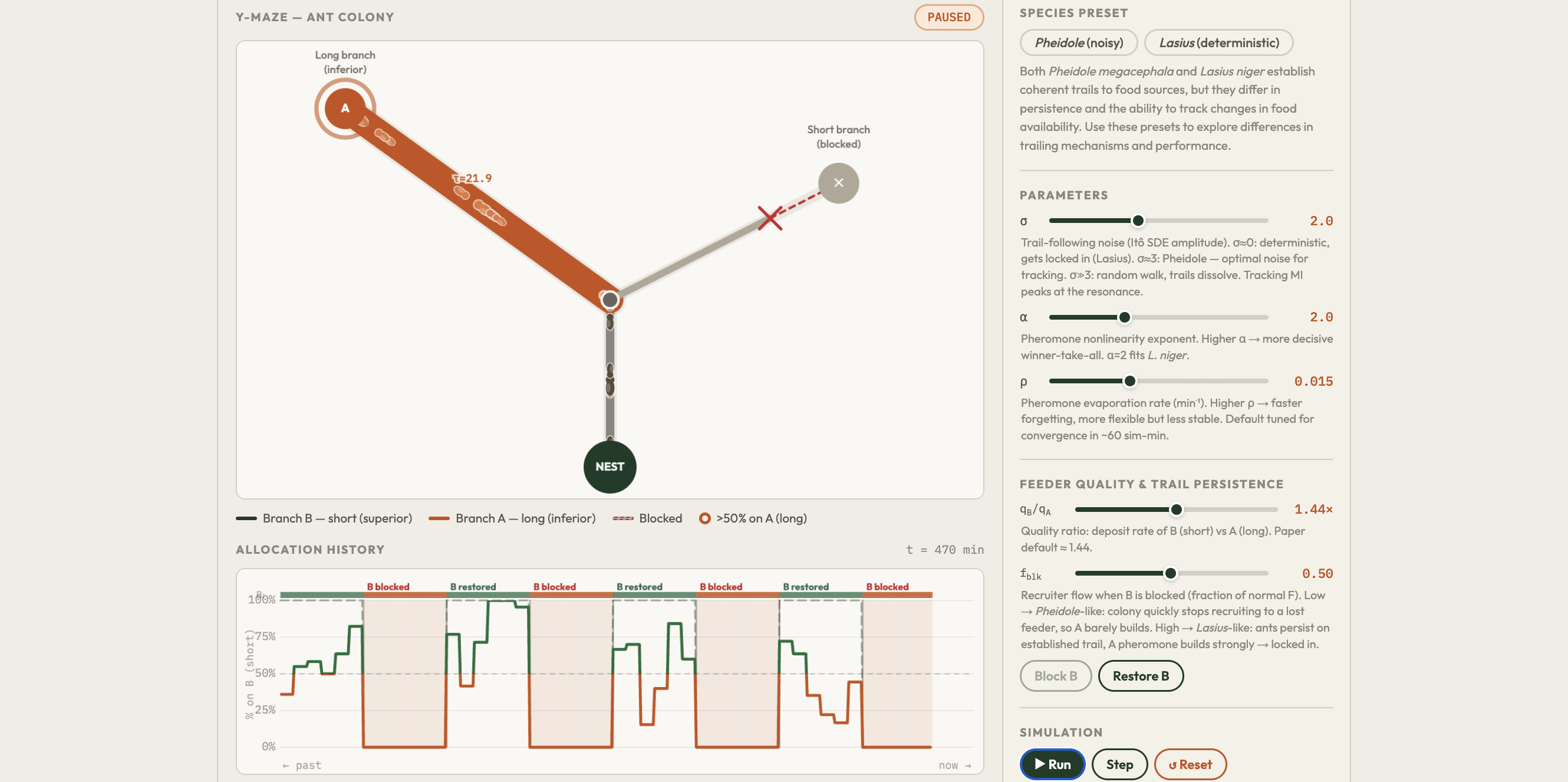
Ant Foraging Dynamics Explorer — interactive explainer
Explore how ants collectively select foraging trails through pheromone stigmergy: experiment with trail noise and Y-maze decision-making, then see how recruitment linearity shapes collective path selection.
Neural Networks
-
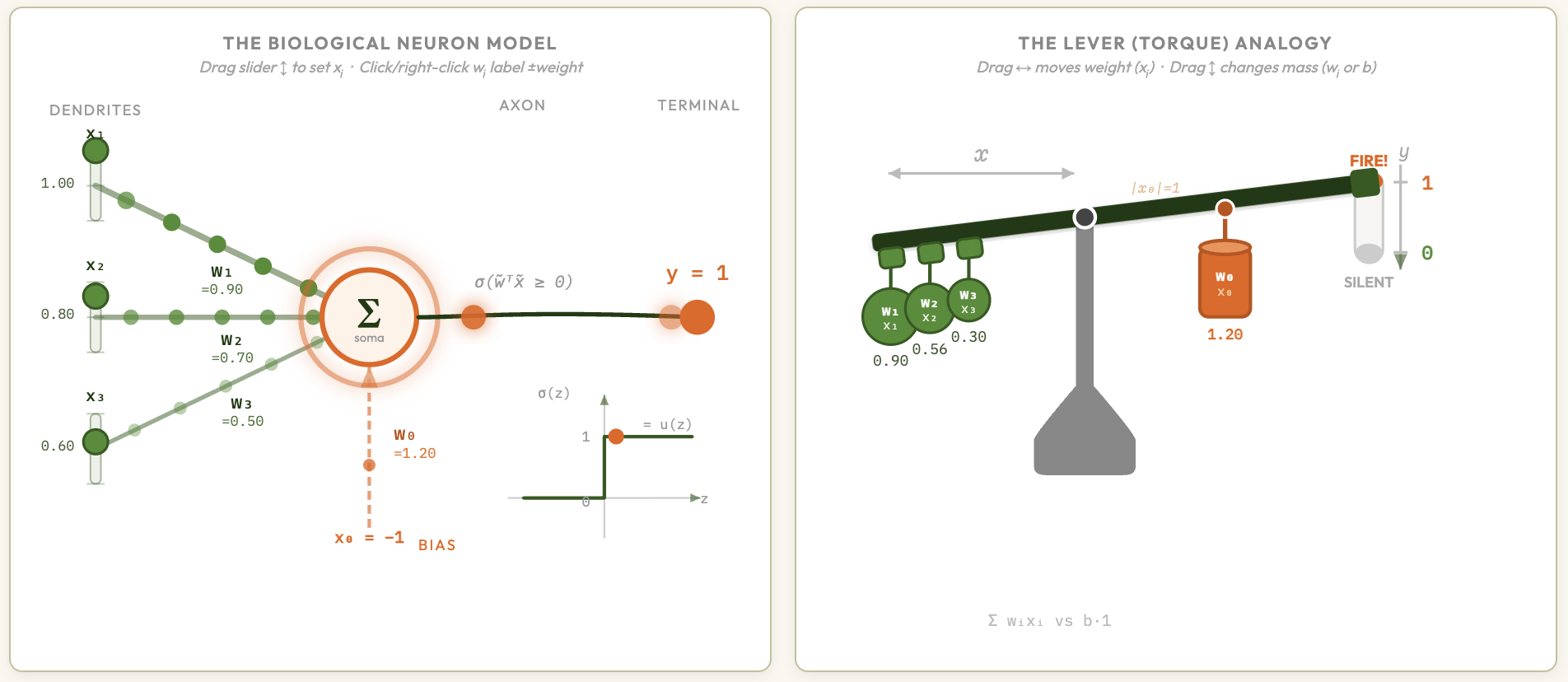
Single-Layer Perceptron — Neuron & Lever Explainer
Animated connection between the biological neuron and the linear classifier — adjust synaptic weights and inputs to watch the decision boundary shift in real time.
-
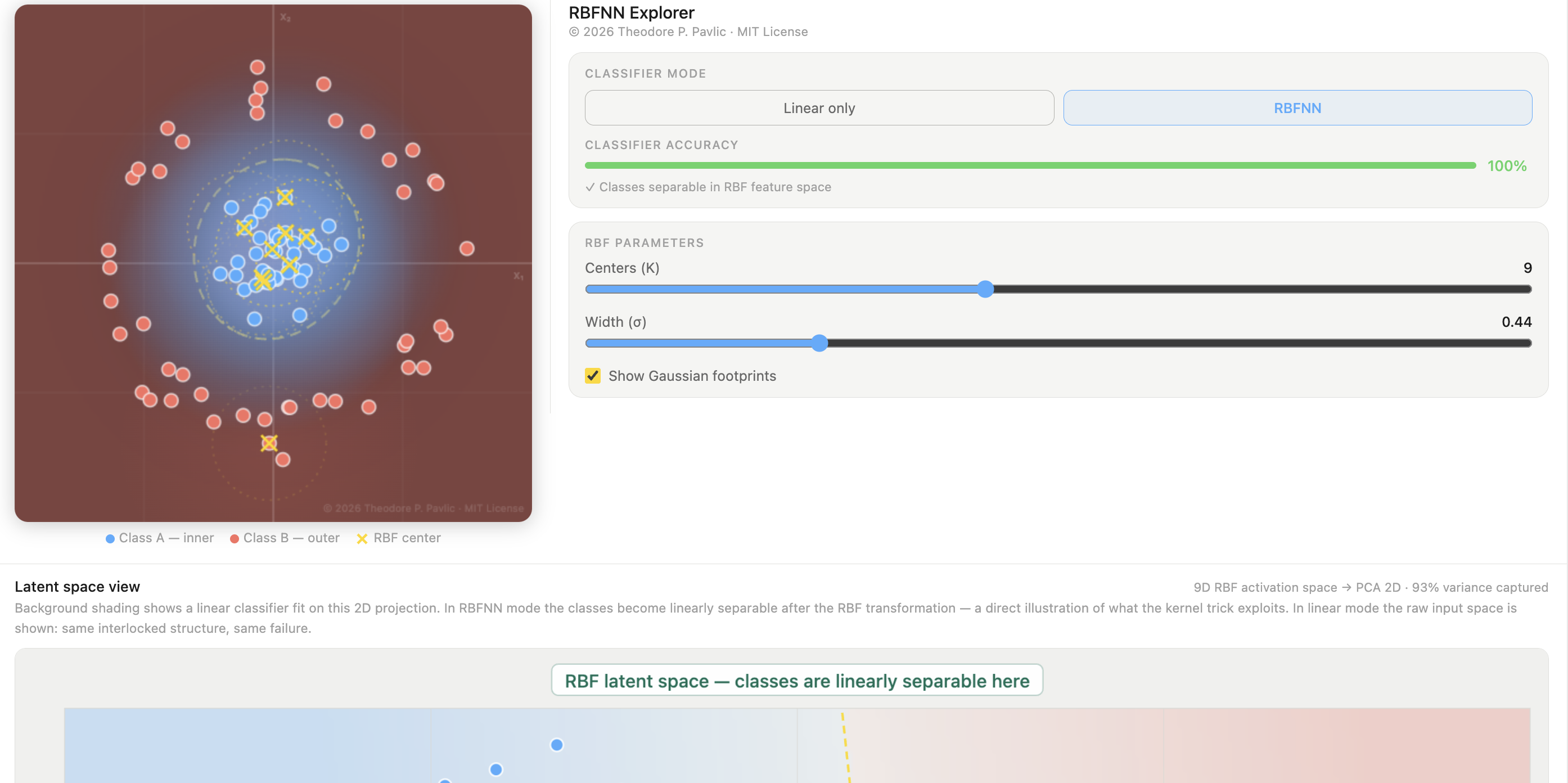
Radial Basis Function Neural Network — interactive explorer
Adjust centers, widths, and weights of radial kernels to see how an RBF network builds up an approximation — making the hidden-layer geometry of this bio-inspired architecture tangible.
-
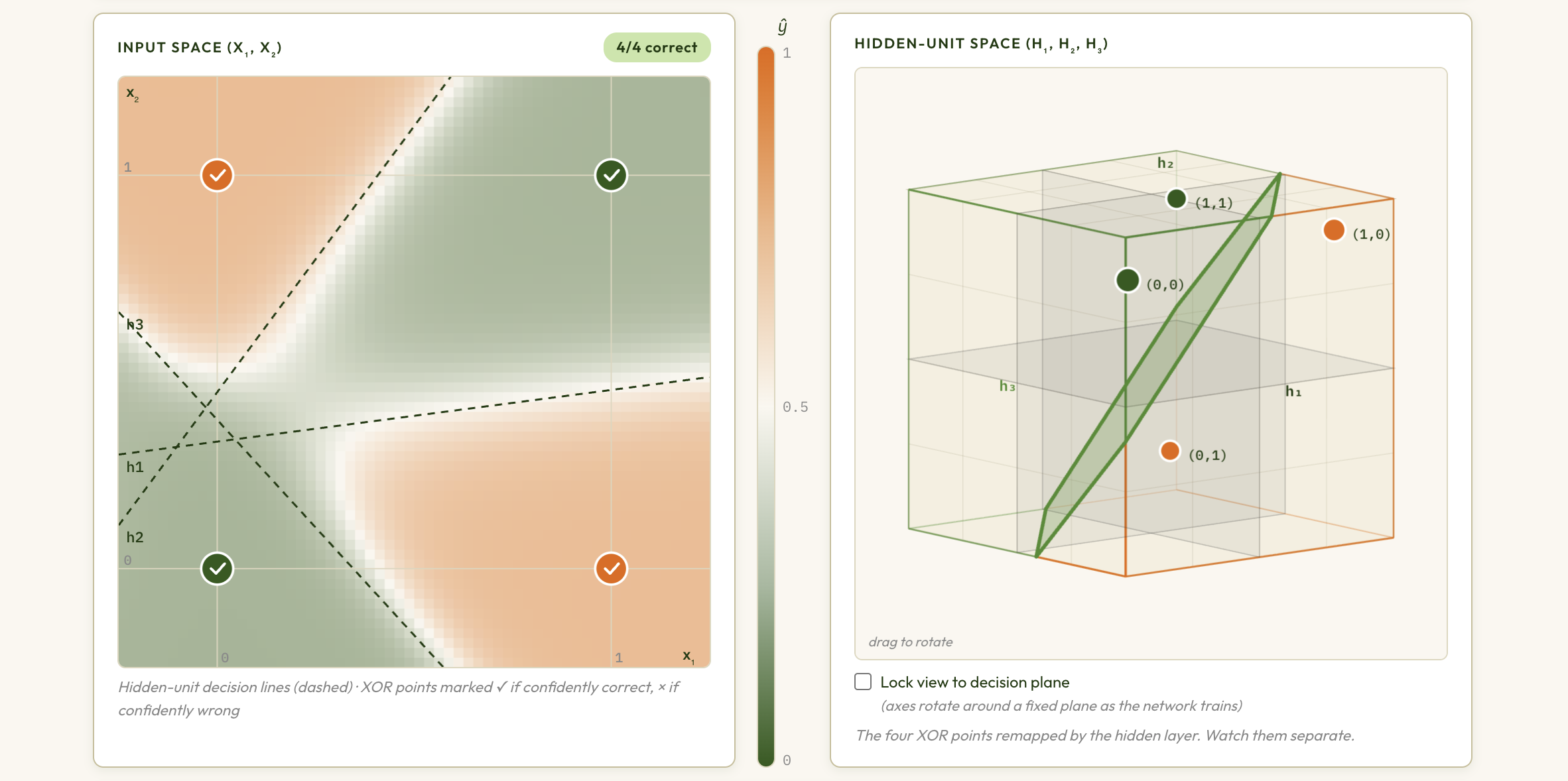
Multi-Layer Perceptron & Backpropagation — interactive explorer
Explore how hidden layers let a network solve XOR and other non-linearly separable tasks, and trace backpropagation as gradient flow through the network's architecture.
-
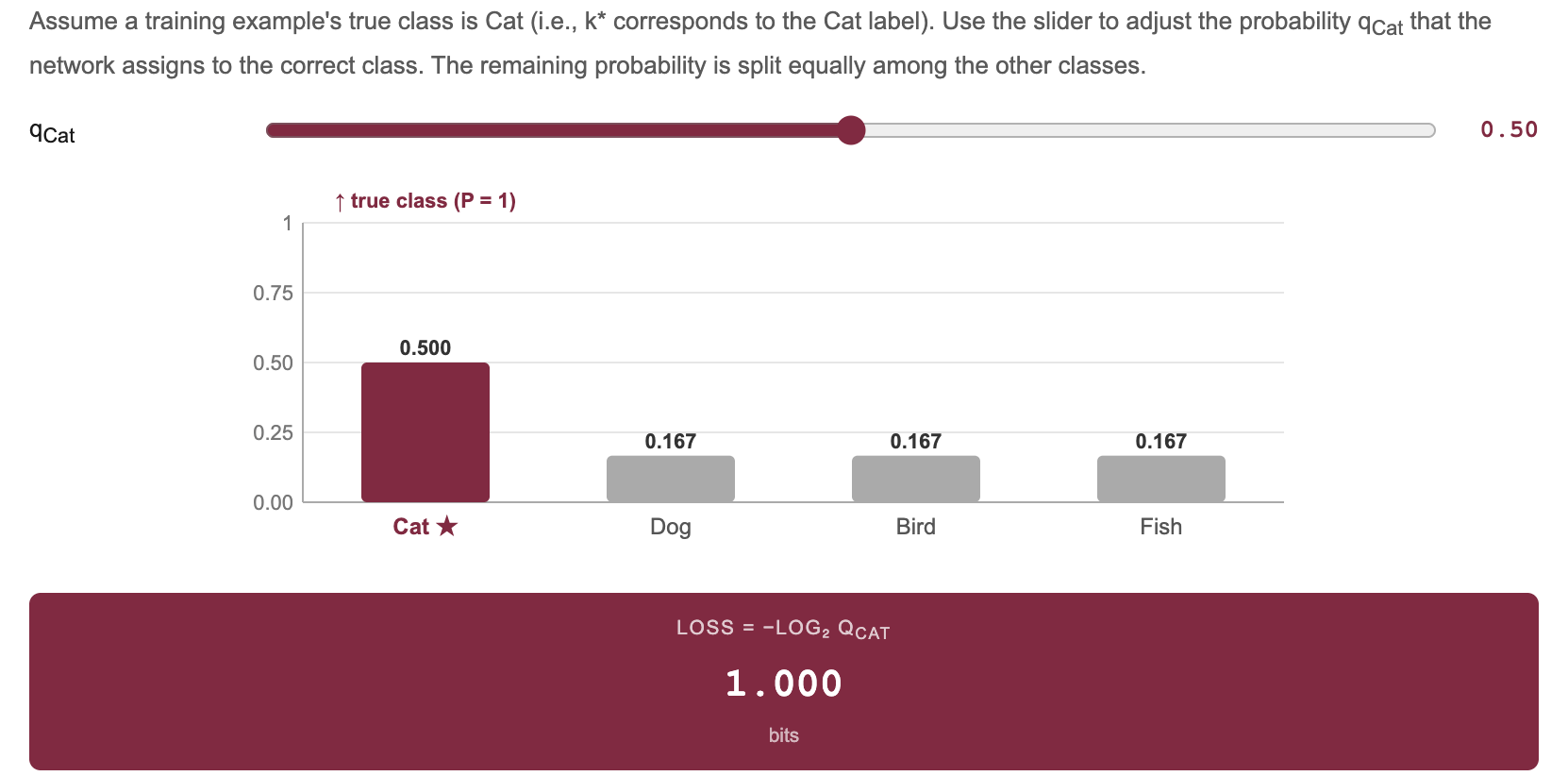
Cross-Entropy — An Information-Theoretic View — interactive explainer
Step from logit scores through softmax and entropy to cross-entropy loss and binary BCE — building the information-theoretic foundation behind neural network classification one concept at a time.
-
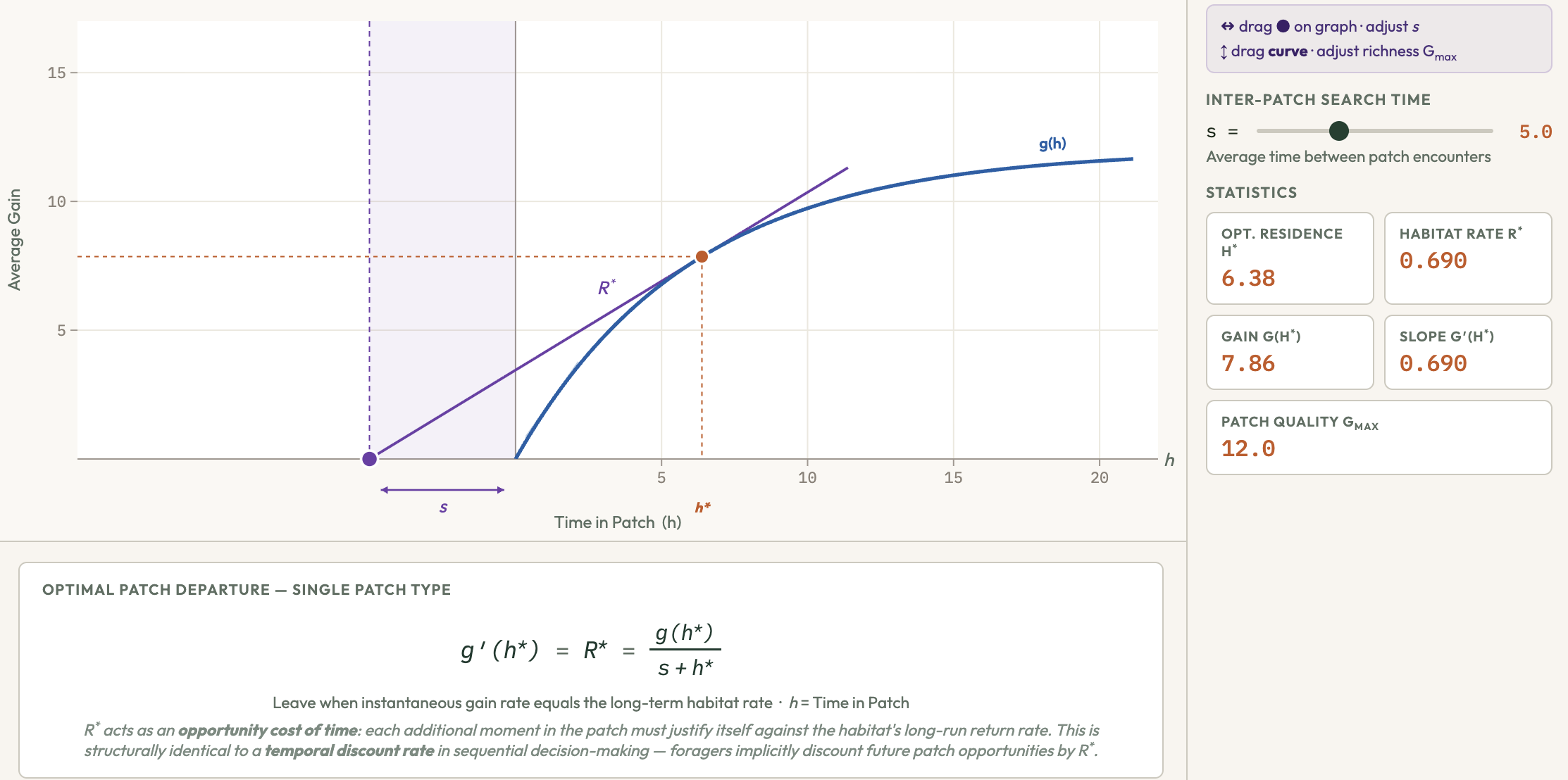
MVT Explorer — Marginal Value Theorem — interactive explainer
Drag the tangent line to find optimal patch residence times under Charnov's Marginal Value Theorem — and see how the habitat-wide rate R* functions as an opportunity cost of time, mirroring the temporal discount rate in the reinforcement learning Bellman equation.
-
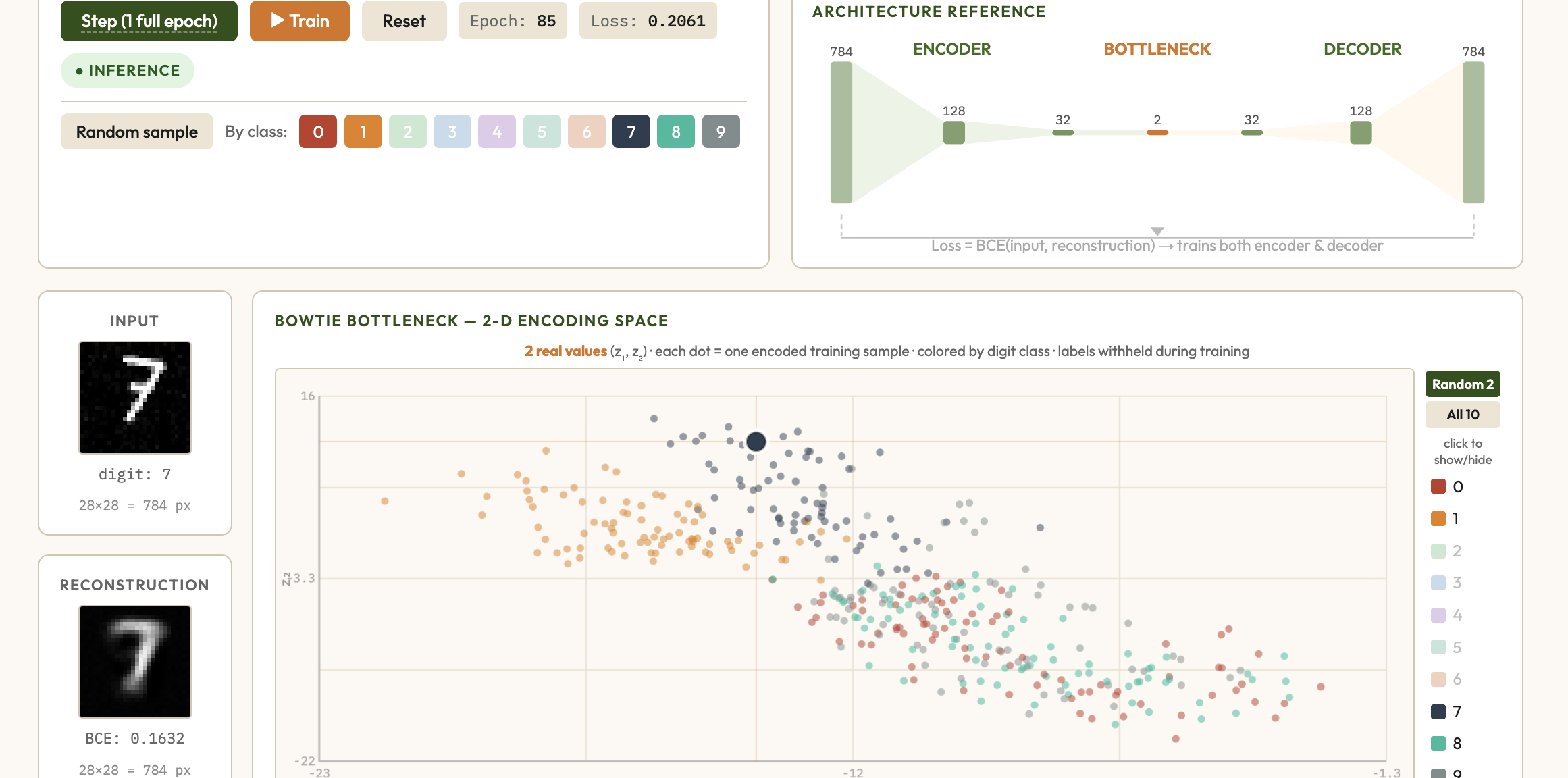
Autoencoder Explorer — interactive explainer
Train a deep autoencoder on MNIST-like digit data and watch the 2-D bottleneck encoding cluster by class — a hands-on demonstration of unsupervised representation learning with neural networks.
-
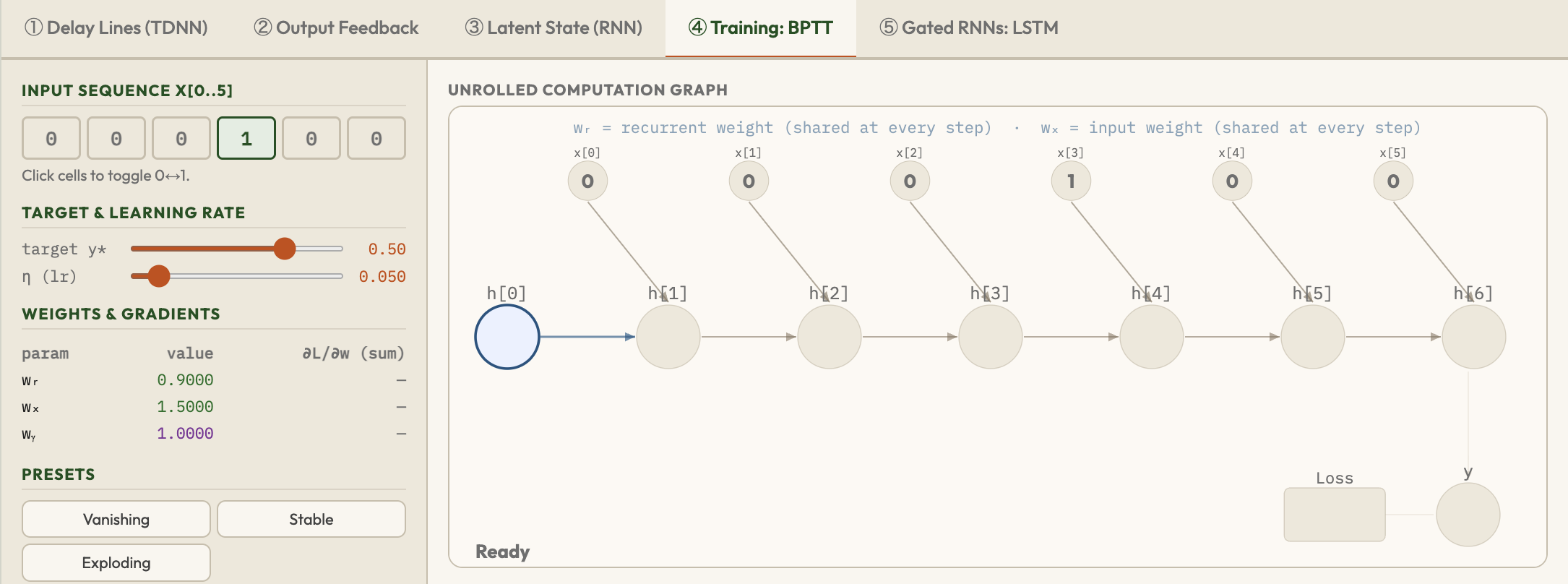
Recurrent Networks & Temporal Supervision Explorer — interactive explainer
Trace the evolution from Time-Delay Neural Networks to RNNs with output feedback and autoregressive latent-state RNNs, train them via Backpropagation Through Time (BPTT), and follow a visual guide to gated architectures (LSTM, GRU) that solve the vanishing-gradient problem.
-
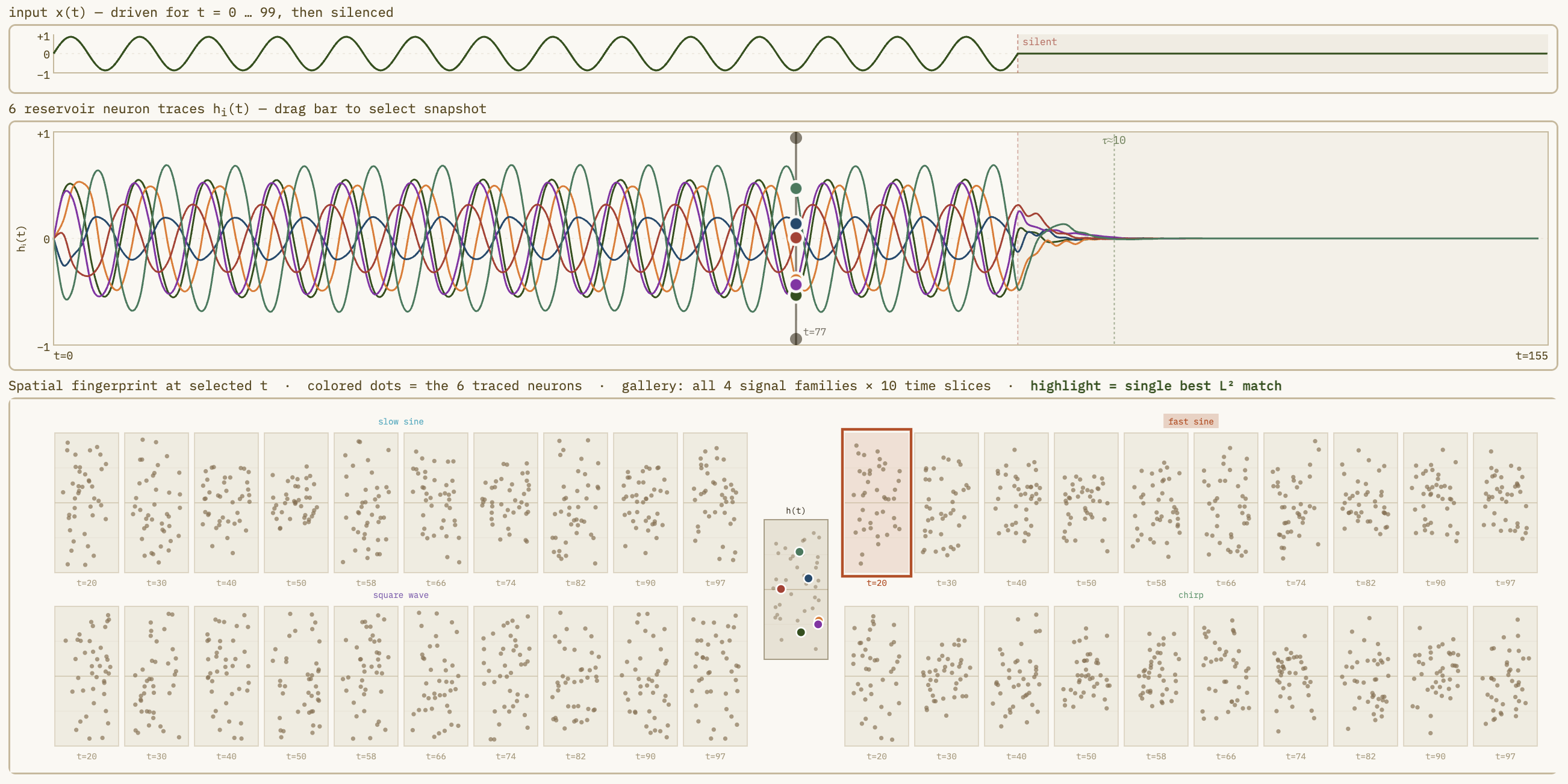
Reservoir Computing — Echo State Network Explorer
Adjust spectral radius, sparsity, and input scaling to watch a fixed random reservoir project inputs into a high-dimensional state space where a simple linear readout can separate complex dynamics — the key insight of reservoir computing via Echo State Networks.
-
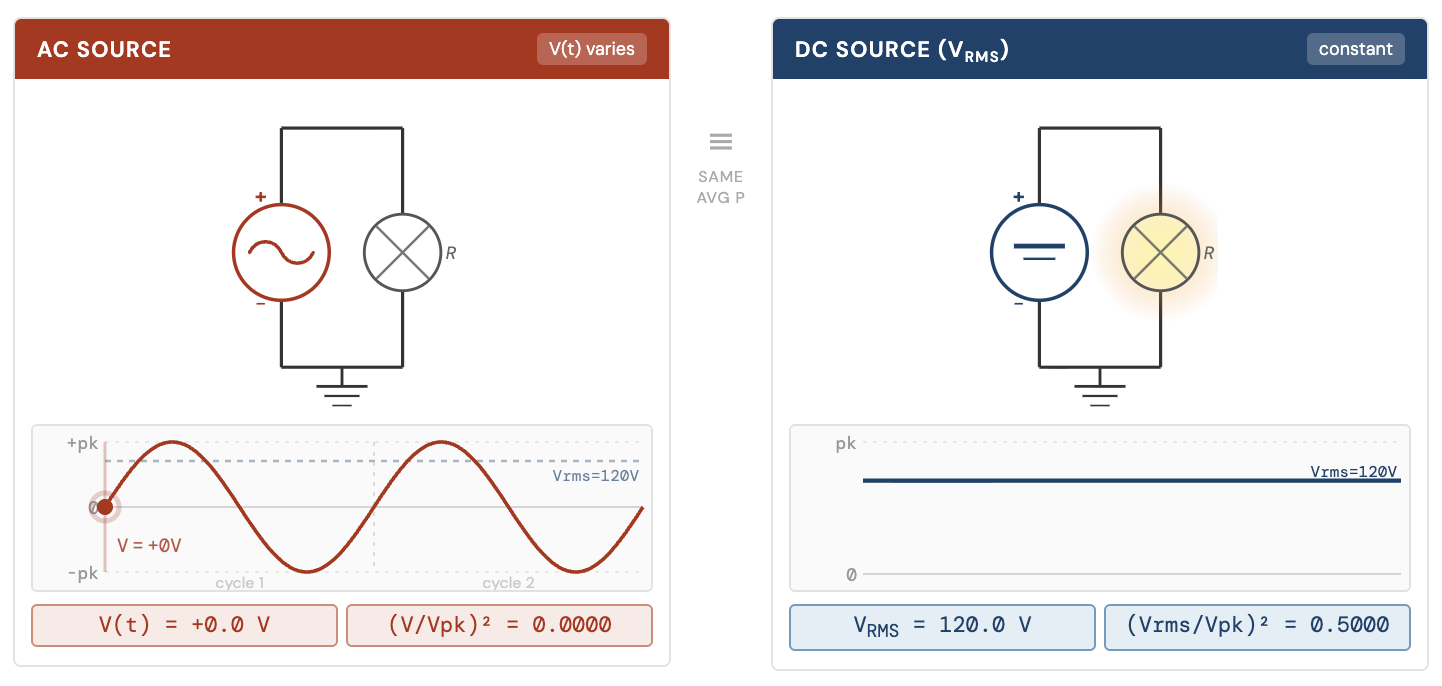
RMS Voltage — Power Dissipation Explorer — interactive explainer
Switch between sine, square, triangle, and sawtooth waveforms to see how RMS voltage depends only on waveform shape and equals the DC voltage that dissipates the same power — building signal-energy intuition that underpins reservoir state analysis.
-
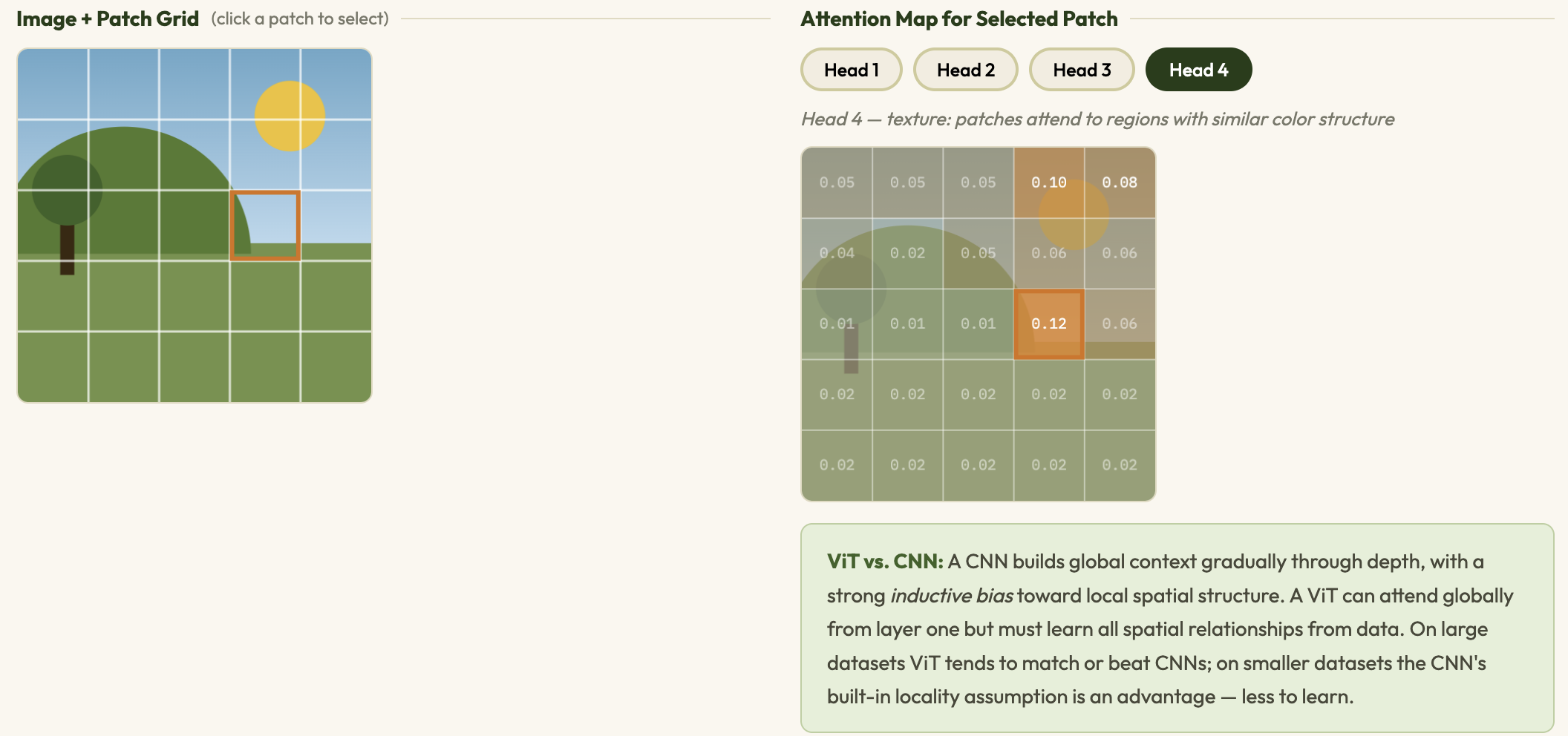
Transformer Architecture Explorer — interactive explainer
Step through scaled dot-product self-attention, multi-head attention, positional encodings, and Vision Transformers (ViT) with live attention-map and patch-embedding visualizations.
-
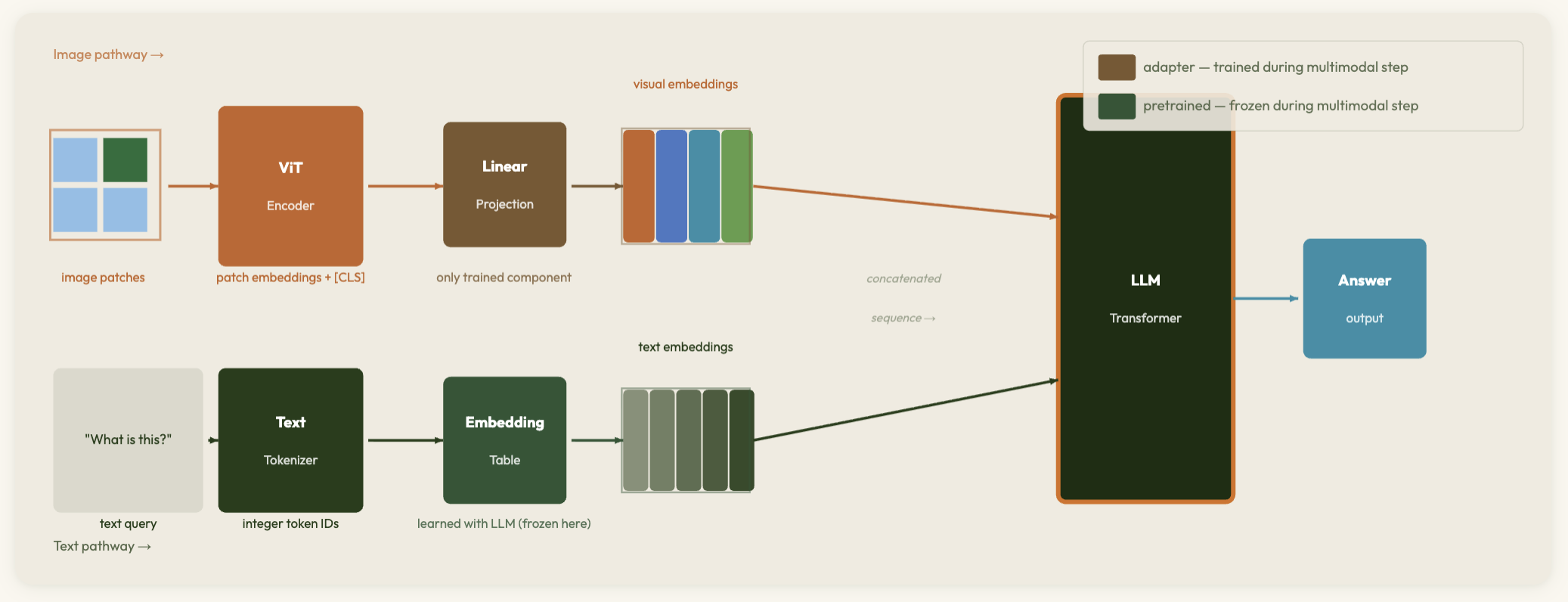
Toward Multimodal AI — interactive explainer
Trace the path from CNNs and patch embeddings to Vision Transformers, CLIP-style contrastive pretraining, and modern multimodal architectures — showing how a single attention mechanism unifies vision and language.
-
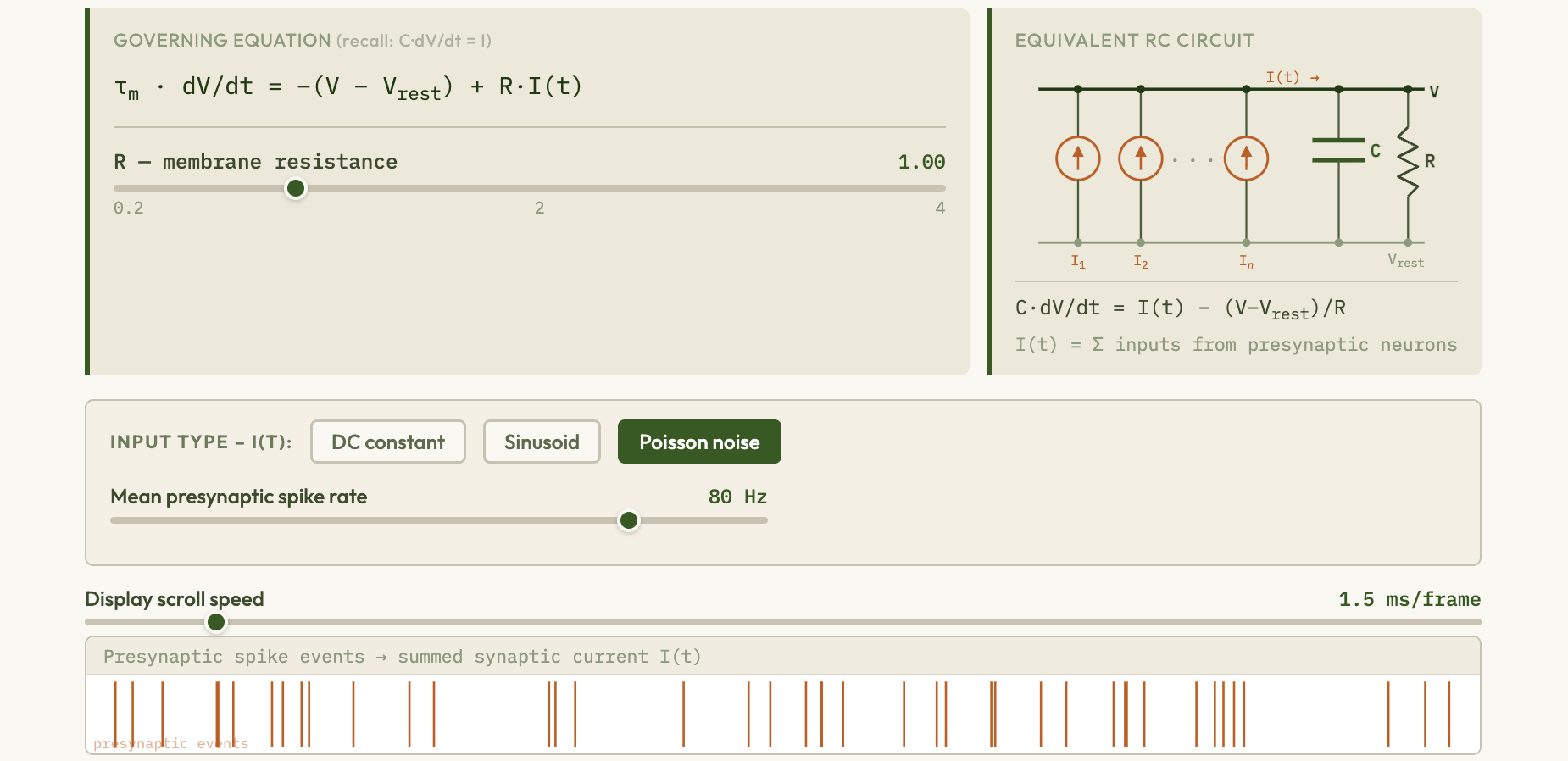
Spiking Neural Networks — interactive explorer
Simulate leaky integrate-and-fire neurons, visualize spike trains and membrane potentials, and explore Spike-Timing-Dependent Plasticity (STDP) — the biologically plausible Hebbian learning rule linking neural firing timing to synaptic weight changes.
-
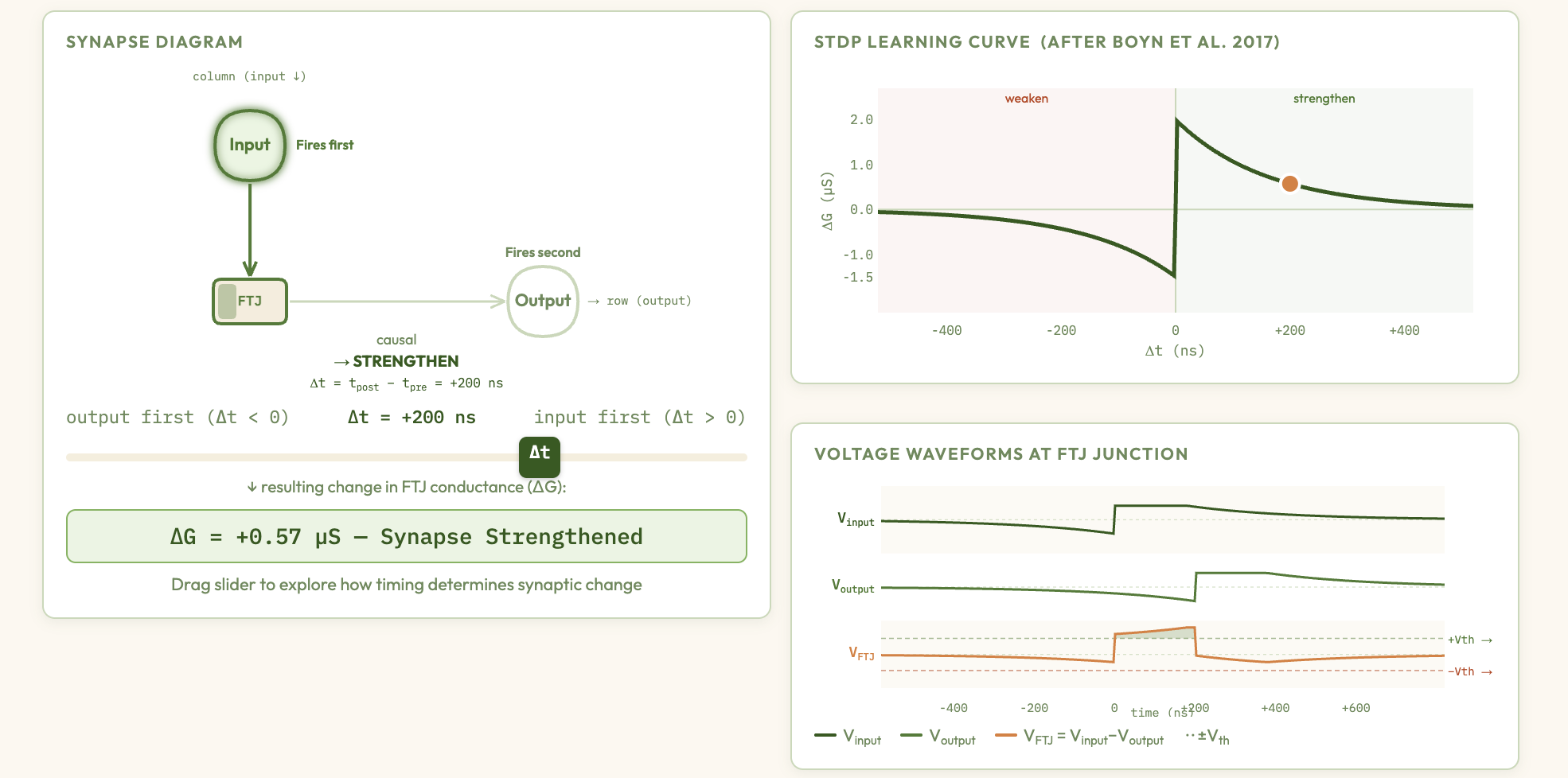
Ferroelectric Memristor Synapses & Crossbar Learning — interactive explainer
Explore how ferroelectric memristor synapses in a crossbar array implement Spike-Timing-Dependent Plasticity (STDP) — adjust pulse timings, device parameters, and network architecture to watch Hebbian learning emerge from nanoscale physics.
-
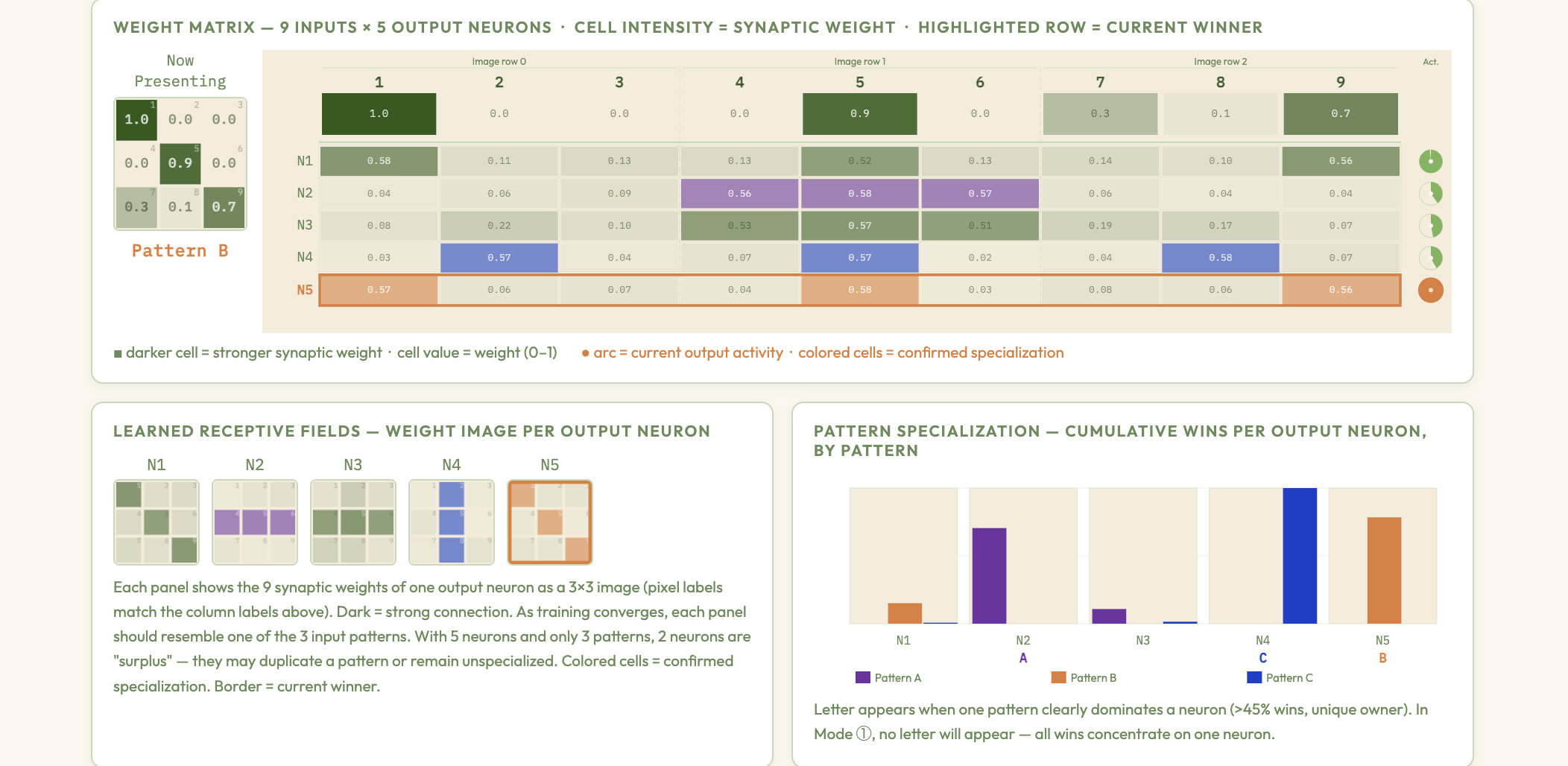
Hebbian Learning & Competitive Clustering — interactive explainer
Explore how Hebbian synaptic update rules combined with lateral inhibition drive winner-take-all competition, organizing input patterns into distinct clusters without supervision — bridging the STDP memristor demo to classical unsupervised ANN learning.
Cellular Automata
-
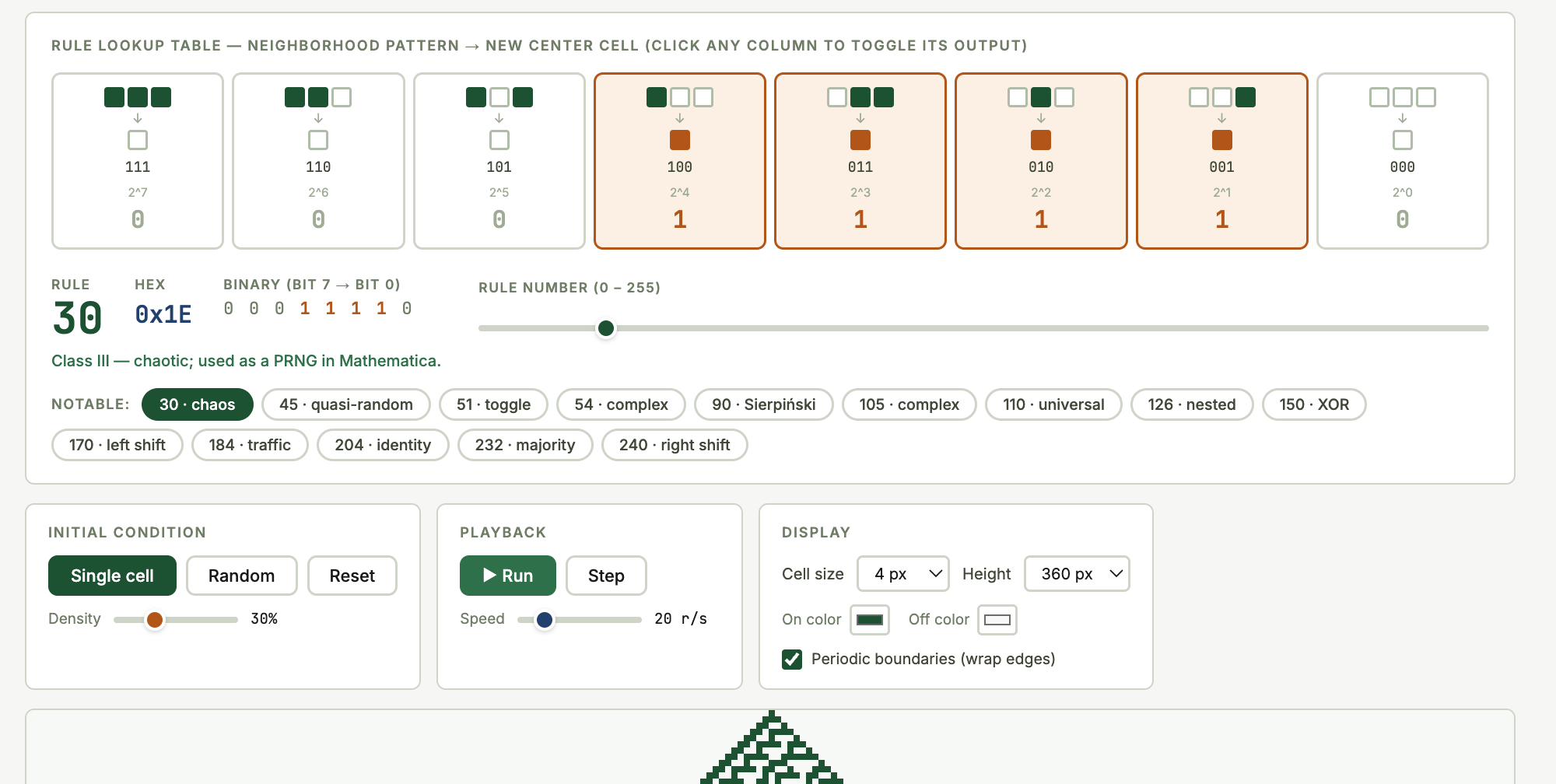
ECA Explorer — Elementary Cellular Automata
Explore all 256 of Wolfram's elementary cellular automaton rules: pick a rule, seed the first row, and watch how simple local update logic generates everything from simple repetition to complex, seemingly random patterns.
-
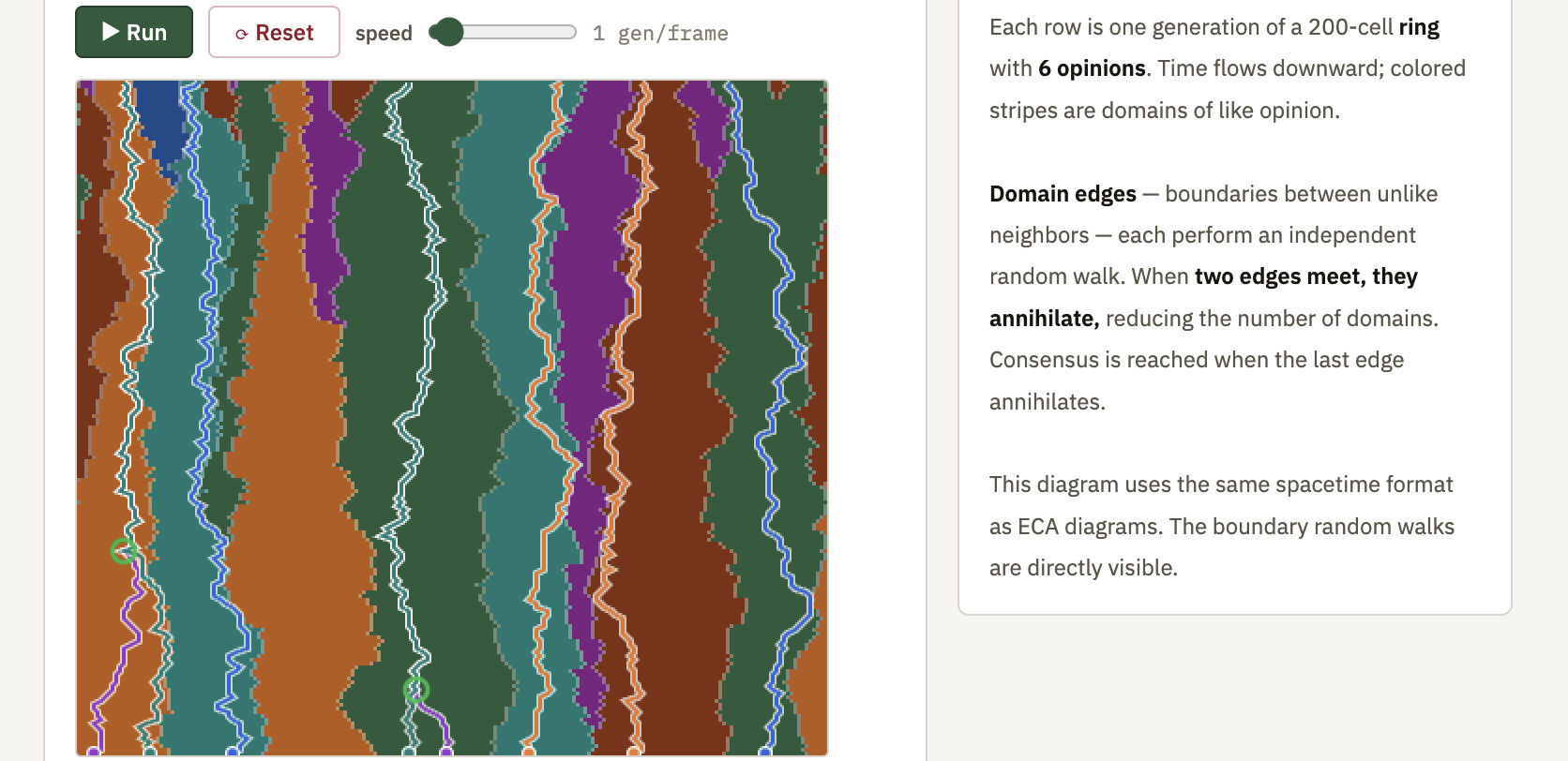
Voter Model & Consensus Dynamics — interactive explainer
Watch cells adopt their neighbors' opinions through local copying rules — and see how a simple stochastic CA reaches consensus, coexistence, or fragmentation depending on network structure and update rules.
More from Ted Pavlic
-
Simulating Stochastic Systems — Course Visualizations
Supplemental visualizations for a separate ASU undergraduate course on simulating systems driven by randomness: random variate generation, discrete-event simulation, queueing, and output analysis.
-
Topic Visualizers — Interactive Explainers
Interactive web demonstrations across science, mathematics, statistics, and engineering.
-
Notes, Documents, & Guides
Markdown-formatted notes and instructional guides on a variety of fundamental and applied science and engineering topics.
-
Lectures and short video tutorials on YouTube
Including the Office Hours playlist.