Simulating Stochastic Systems – Course Visualizations
Supplemental visualizations for Theodore Pavlic's Simulating Stochastic Systems at Arizona State University.
Lectures and other helpful short video tutorials can be found at TedPavlic's YouTube channel.
© 2026 Theodore P. Pavlic · MIT License
Monte Carlo Methods
-
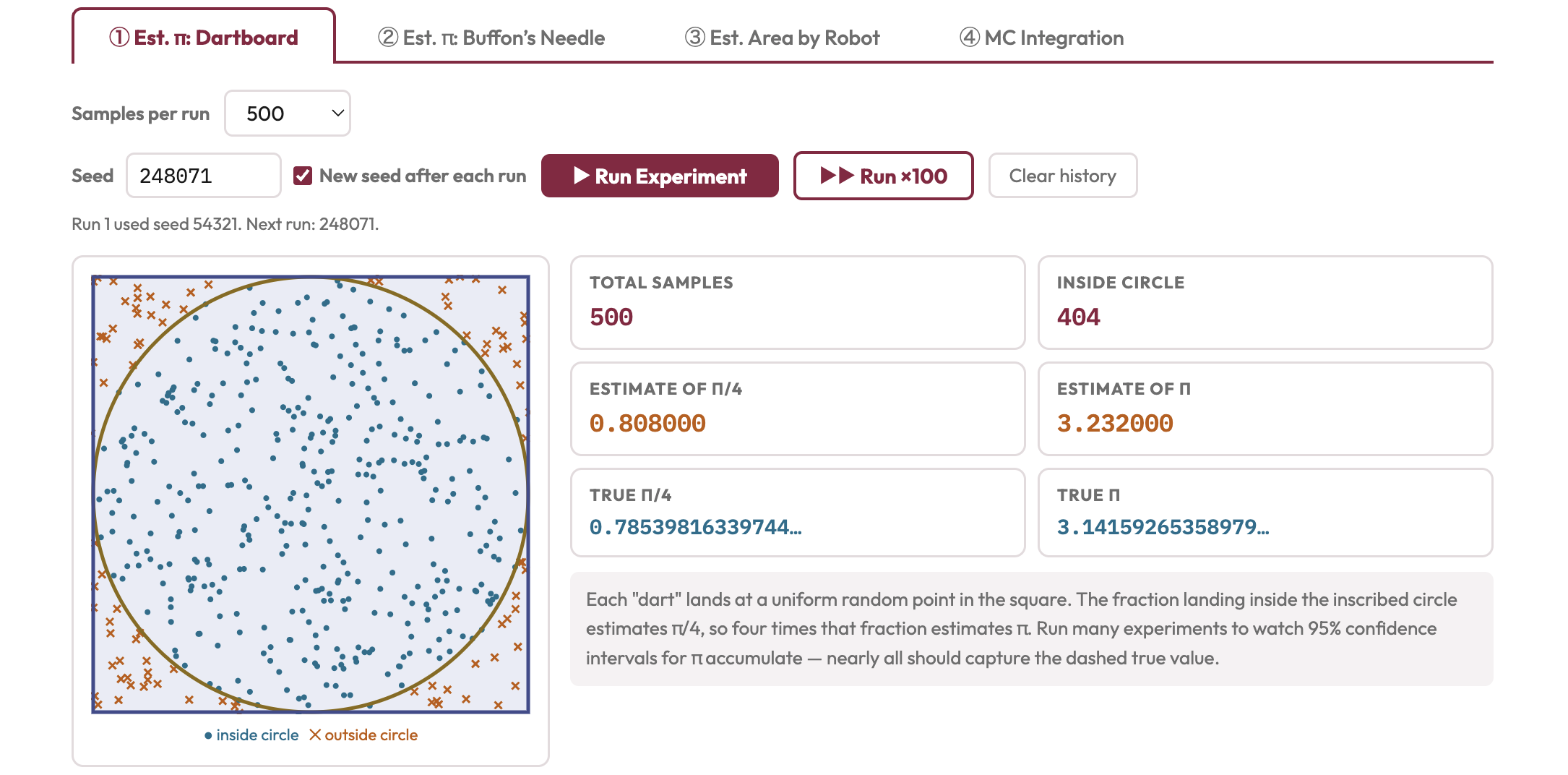
Monte Carlo Explorer – interactive explainer
Estimate π by dartboard sampling and Buffon’s needle, measure a floor area from a robot’s crossing trails, and integrate a function by averaging random draws, watching 95% confidence intervals accumulate around the truth.
-
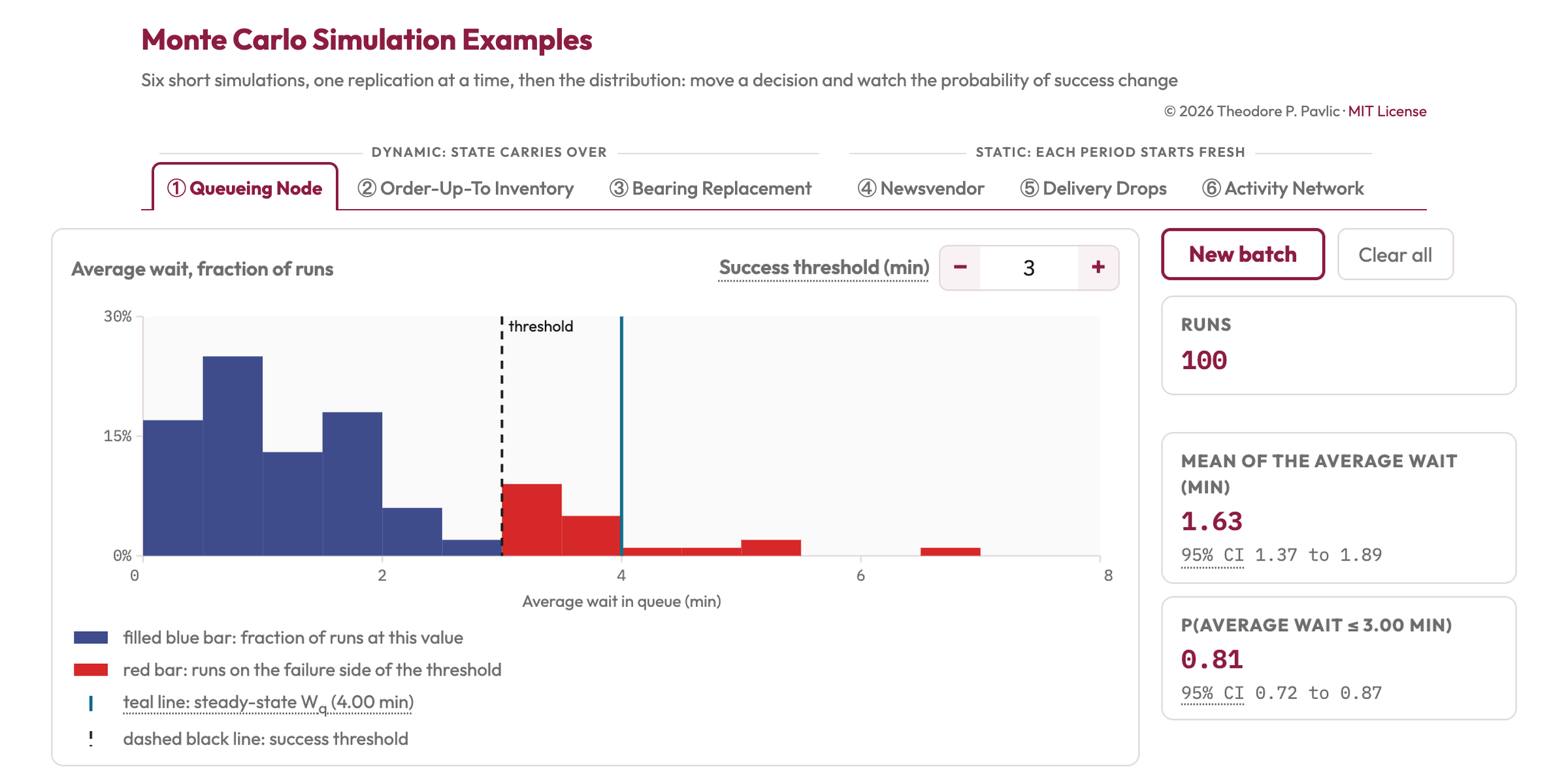
Monte Carlo Simulation Examples – interactive explainer
Step through six short simulations (a queueing node, an inventory policy, bearing replacement, a newsvendor, aid drops, and an activity network) and accumulate replications to watch the probability of success take shape.
Pseudorandom Number Generation
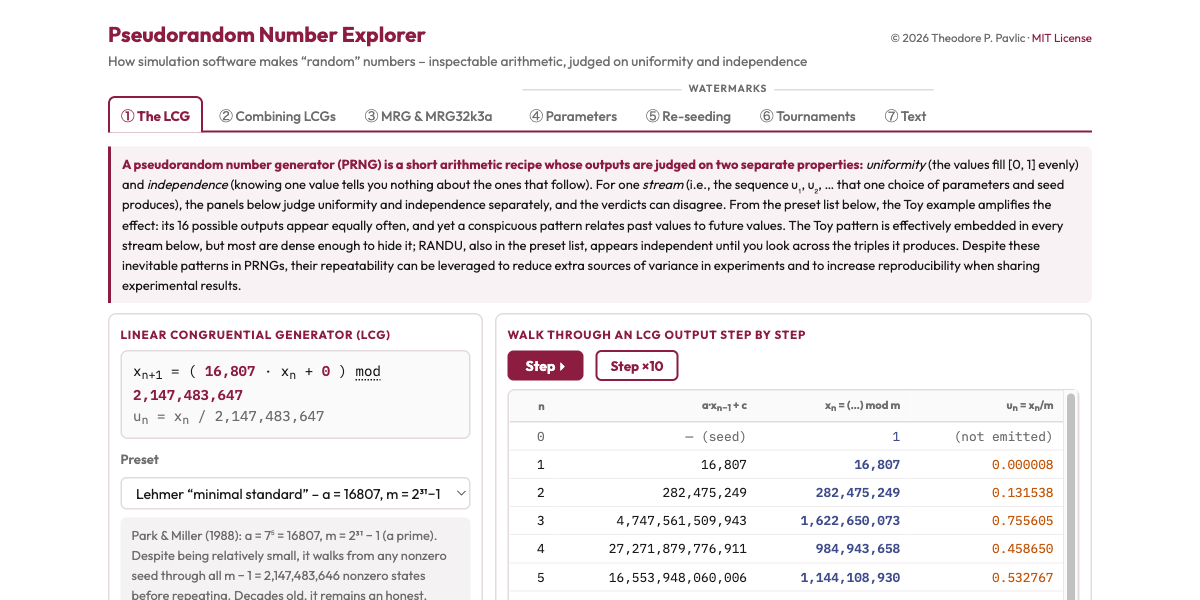
Input Modeling
-
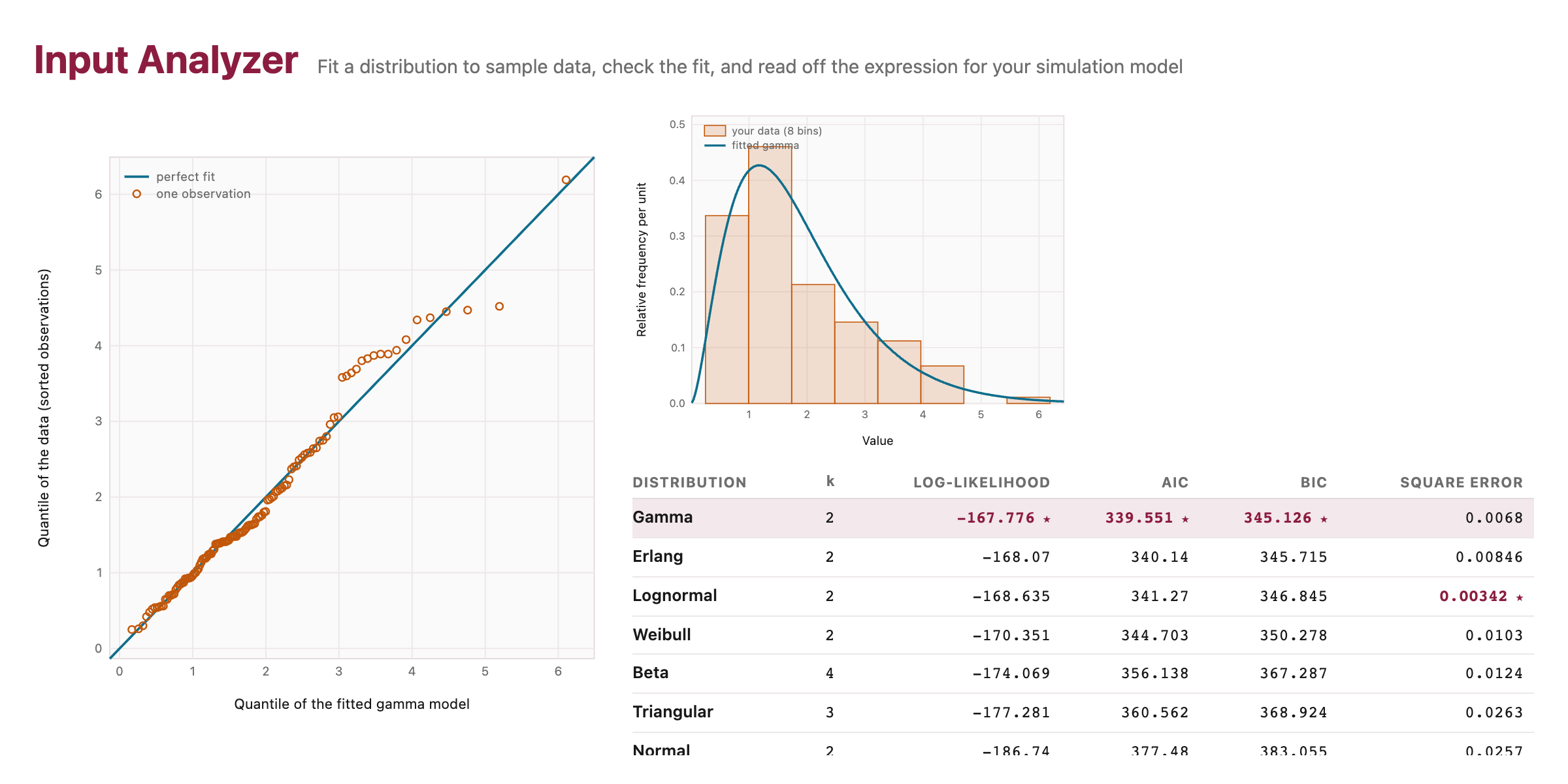
Input Analyzer – analysis tool
Paste sample data and fit fourteen candidate distributions by maximum likelihood, compare them by AIC, BIC, and square error, check the fit with bootstrap goodness-of-fit tests, and export the expression for your simulation tool.
-
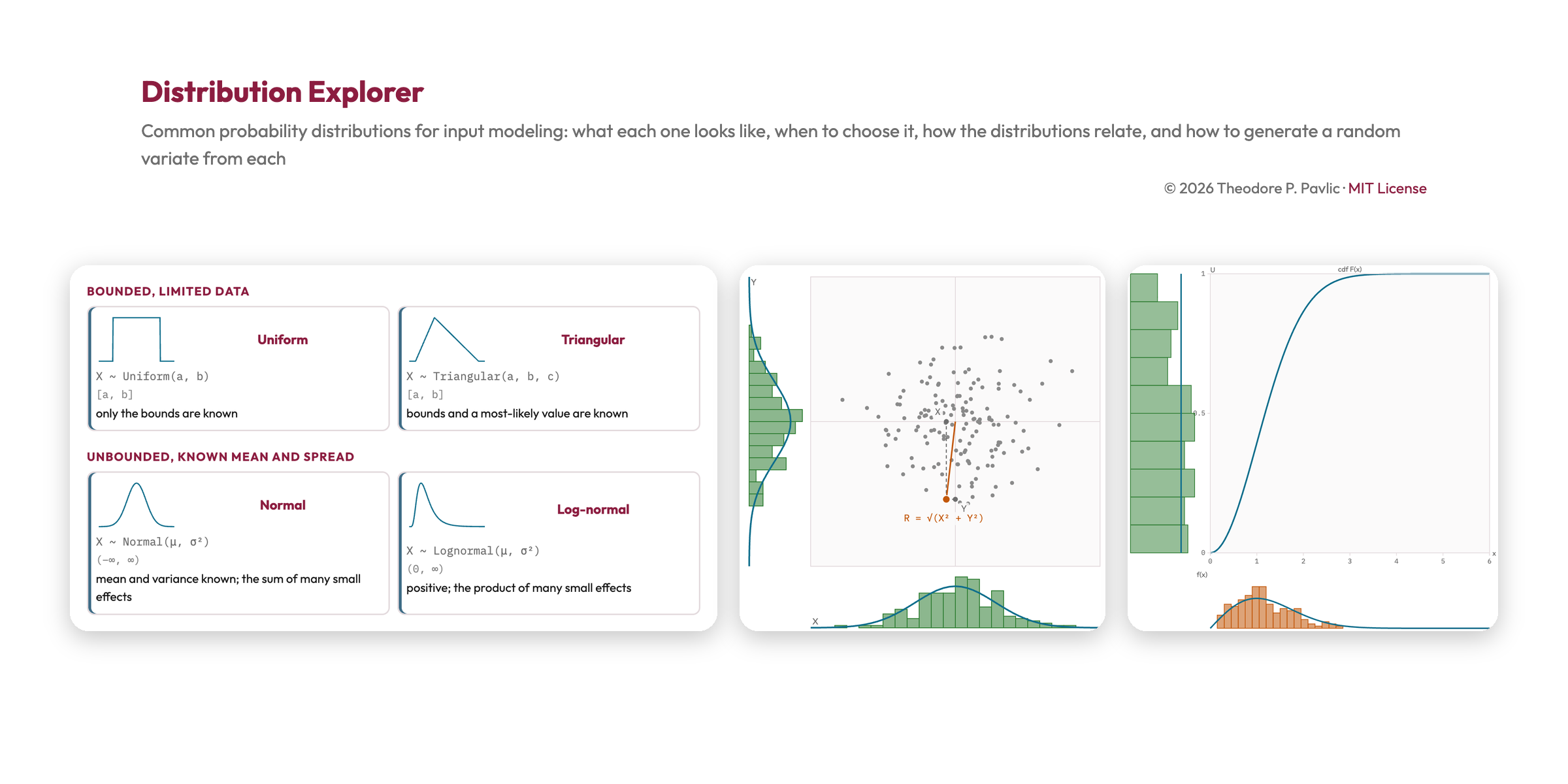
Distribution Explorer – interactive explainer
Browse nineteen input-modeling distributions, each with live pdf and cdf plots, formulas and moments, guidance on when to choose it, and an animated inverse-transform generator.
Output Analysis
-
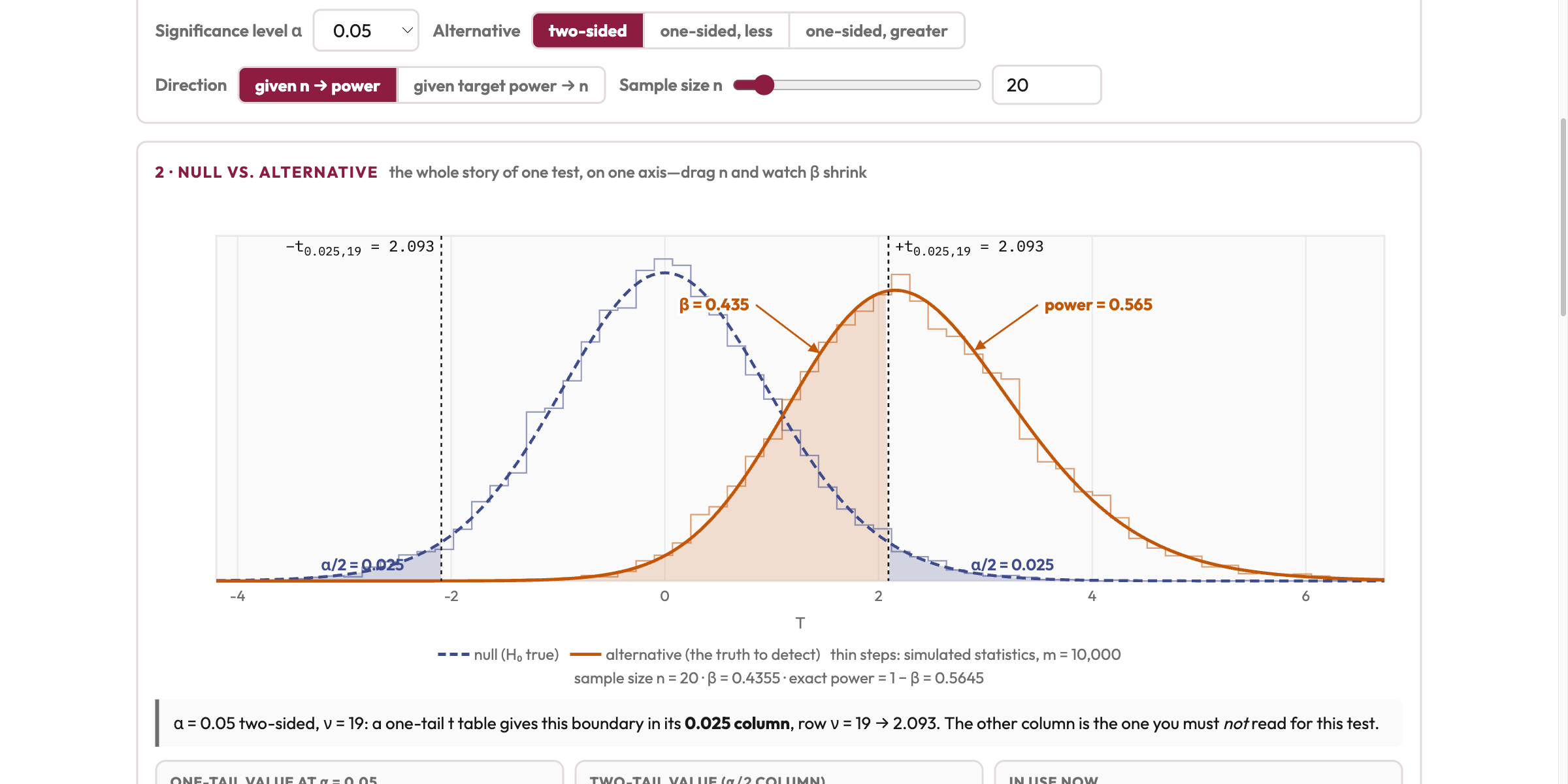
Power Explorer – interactive explainer
Pick a hypothesis test and watch the null and alternative sampling distributions separate as n grows, estimate power by Monte Carlo and by formula, and solve for the replications a target power needs.
-
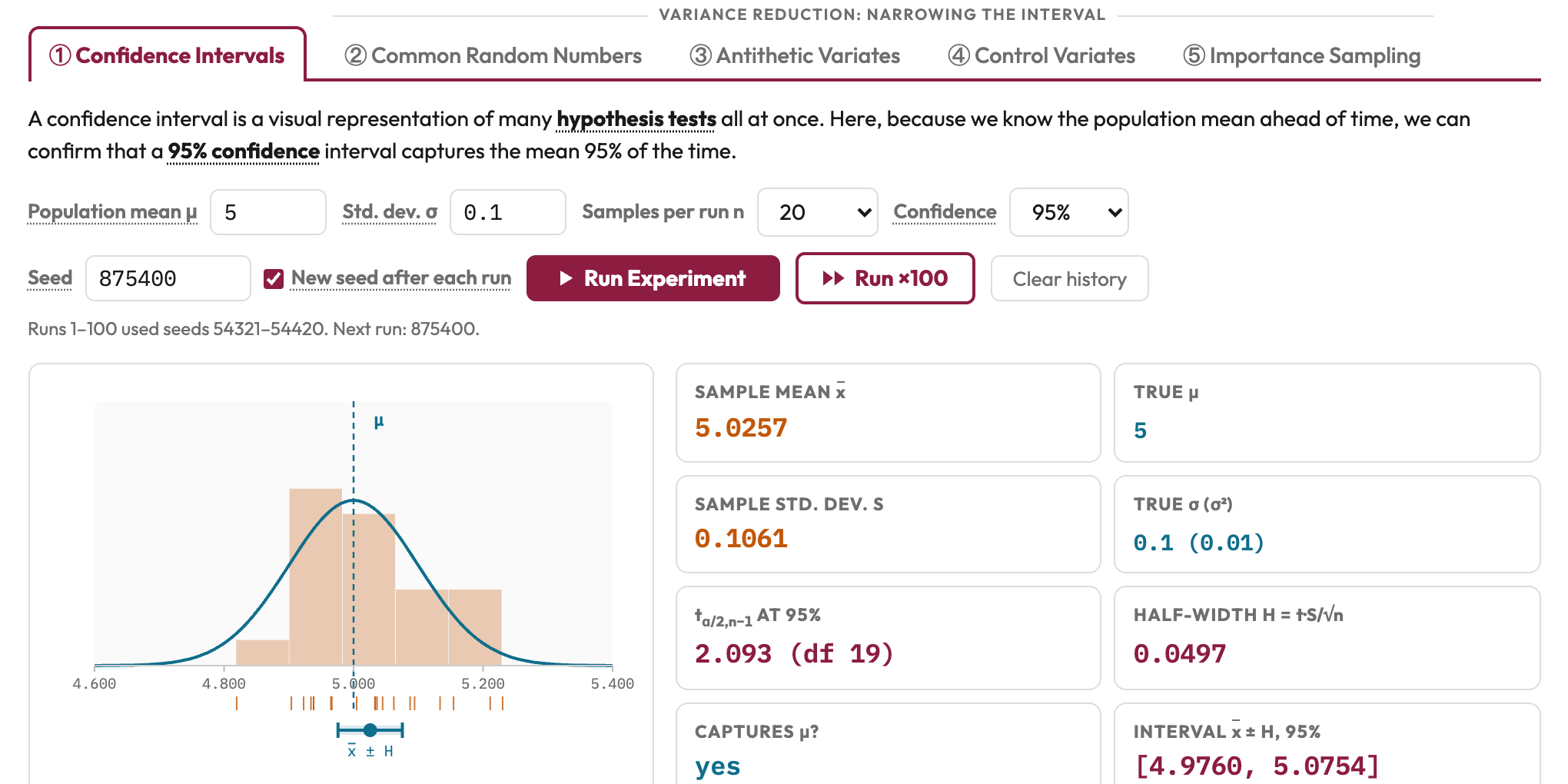
Confidence Interval and Variance Reduction Techniques Explorer – interactive explainer
Build t intervals from samples of a known population and watch about α of them miss the truth, then narrow them with common random numbers, antithetic variates, control variates, and importance sampling.
-
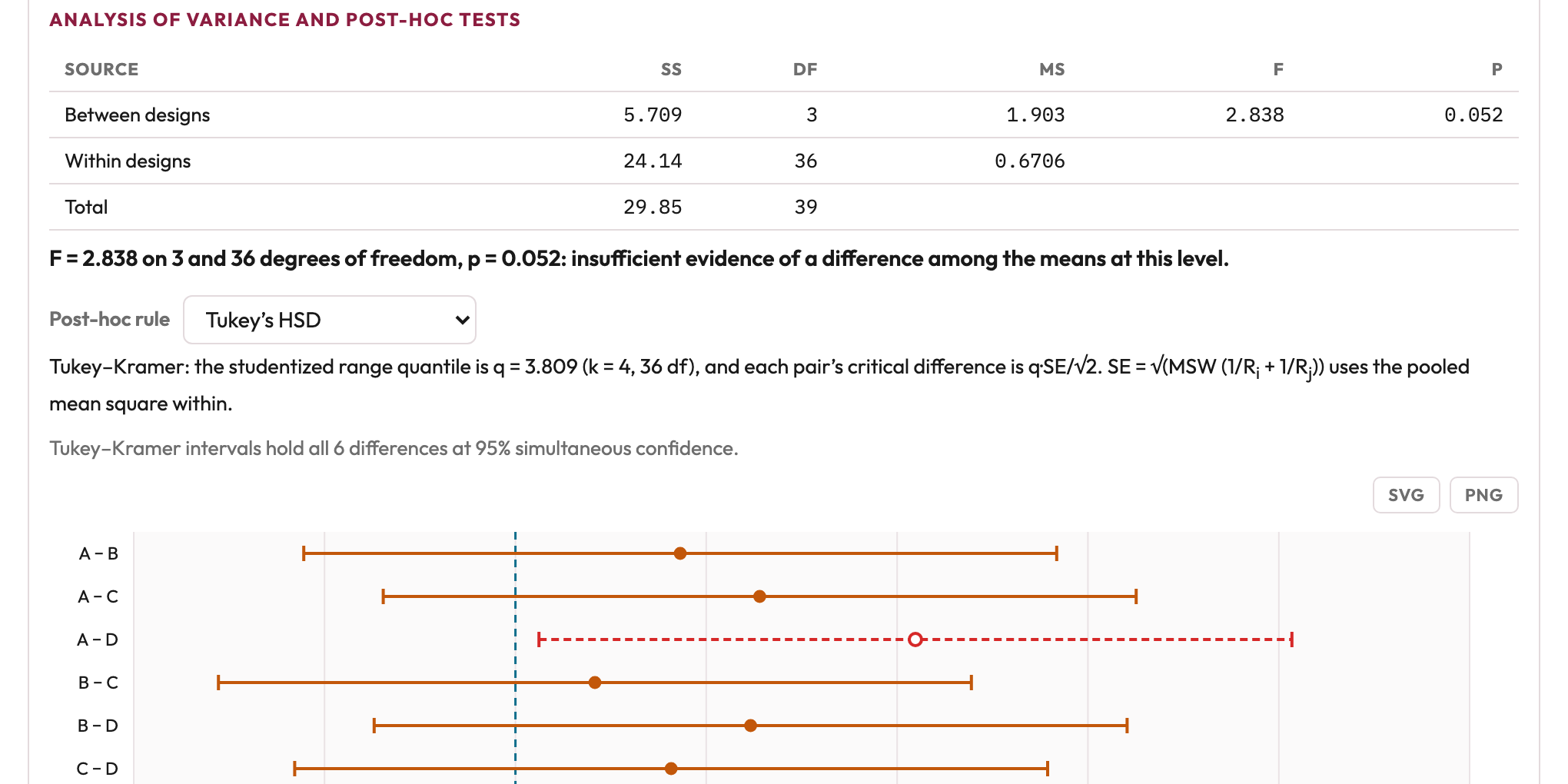
Output Analyzer – analysis tool
Load simulation output and form the right interval: t intervals on replication means, comparisons of two or several designs with post-hoc tests and a best-subset screen, and a steady-state workspace with warm-up truncation and batch means.
More from Ted Pavlic
-
Bio-Inspired AI & Optimization – Course Visualizations
Supplemental visualizations for a separate ASU graduate course on optimization and multi-agent control inspired by biological and physical systems: genetic algorithms, evolution strategies, swarm intelligence, and neural computation.
-
Topic Visualizers – Interactive Explainers
Interactive web demonstrations across science, mathematics, statistics, and engineering.
-
Notes, Documents, & Guides
Markdown-formatted notes and instructional guides on a variety of fundamental and applied science and engineering topics.
-
Lectures and short video tutorials on YouTube
Including the Office Hours playlist.